
Operation Epic Fury: emerging environmental harm and risks in Iran and the region
Published: March, 2026 · Categories: Publications
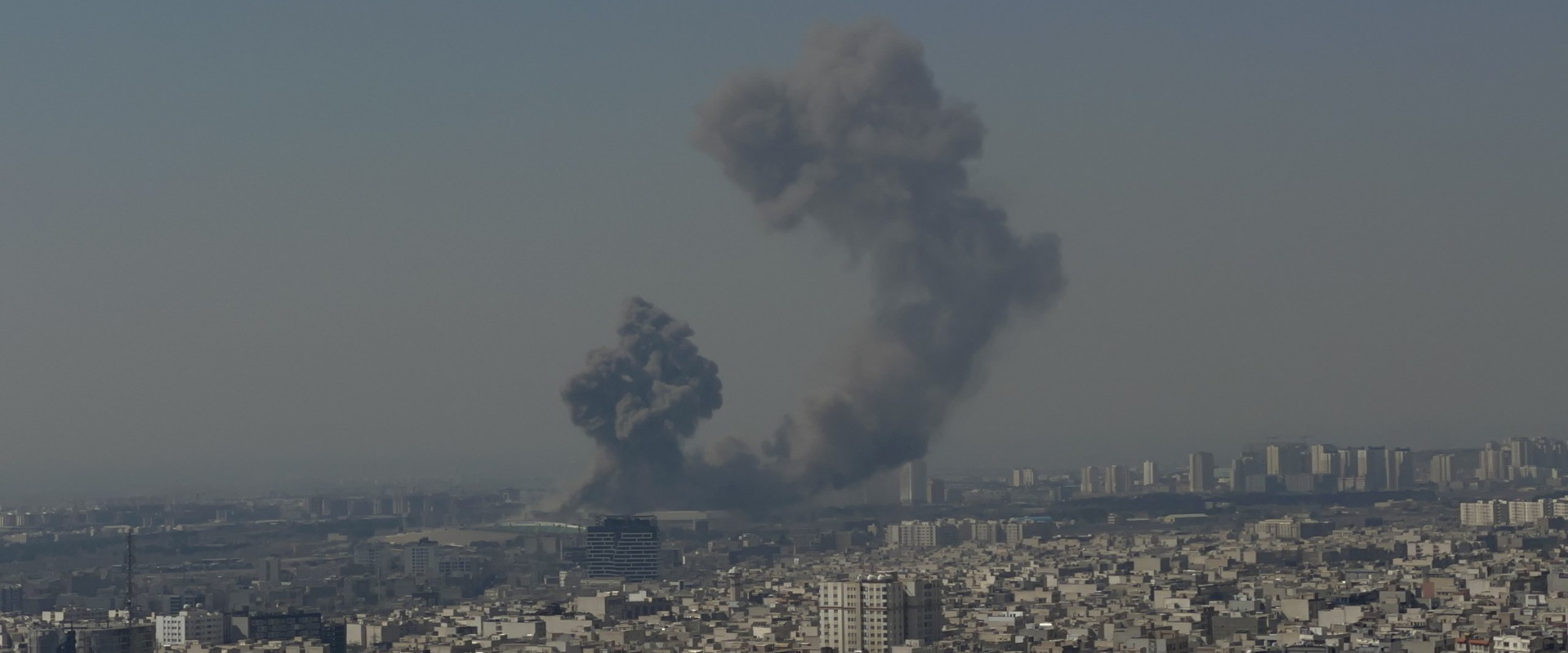
An updated overview of emerging environmental issues and perspectives arising from Operation Epic Fury in Iran, Israel, and the Gulf States. We have seen a continuation — since our 3 day assessment — of pollution incidents that are placing people and ecosystems at risk of acute and long-term harm, and trends that could lead to substantial environmental damage as the war continues.
Introduction
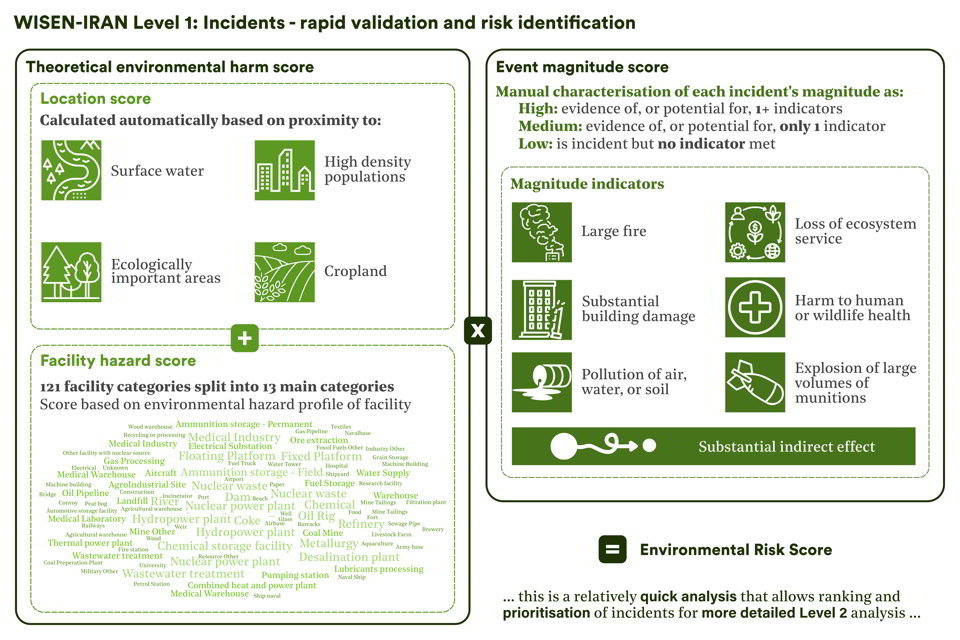
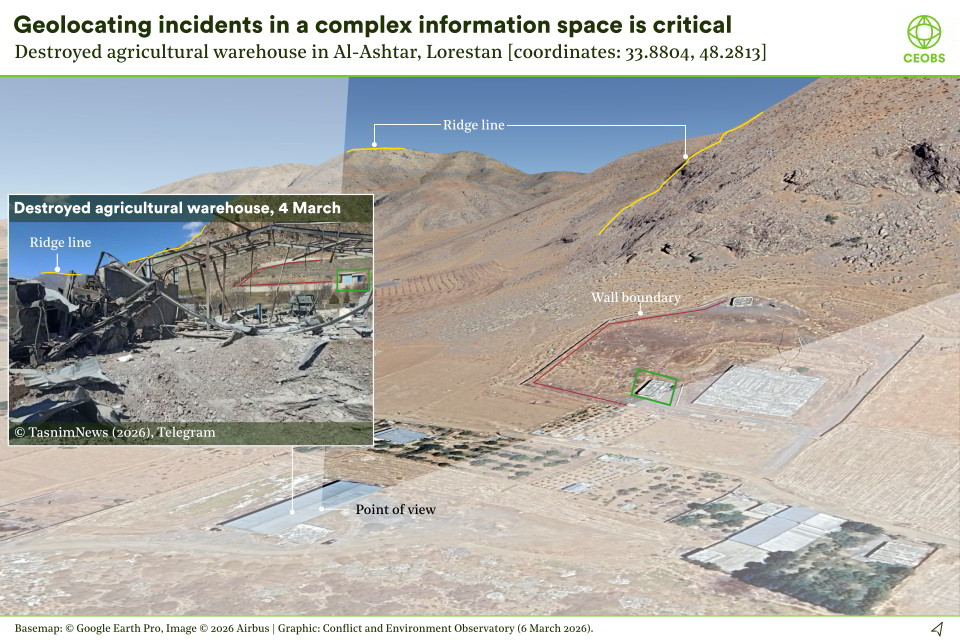
To understand the nature and scale of environmental harm CEOBS has been identifying environmentally relevant incidents and undertaking a basic risk assessment for each.1 We have searched social and traditional media for incidents and then undertaken a verification and remote environmental assessment using additional social and traditional media footage triaged with satellite imagery.2
As of the 10th March 2026, we have identified over 300 incidents, 232 of which have been assessed for their environmental risk. The results are mapped below, showing incidents in Iran, Iraq, Israel, Kuwait, Jordan, Cyprus, Bahrain, Qatar, the UAE, Saudi Arabia, Oman and Azerbaijan. By far the commonest facility type is a ‘Military Object’ (123). Of those the most impacted sub-type is ‘Airbases’ (26). Away from military sites, incidents cover a range of facility types, with different pollution profiles, from hospitals, to tyre storage sites, to oil refineries. As the conflict proceeds we are seeing more attacks on civilian and dual use infrastructure.
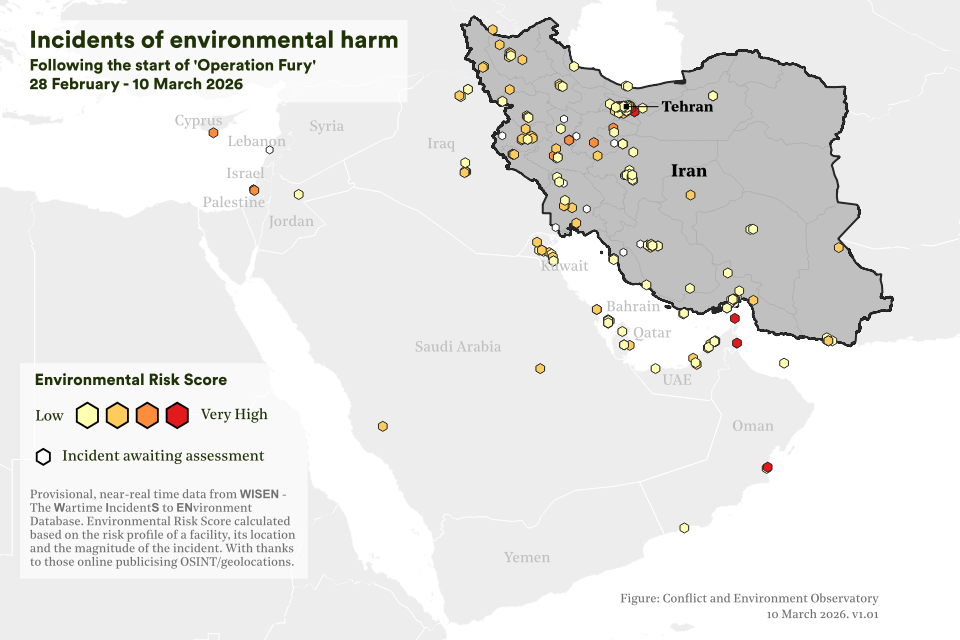
Health warning: incidents are largely identified through social media monitoring. While vetted, they require more comprehensive verification and peer review to fully assess their environmental impacts. Many additional incidents will need to be retrospectively added because of the speed, geographic spread, and chaotic online information environment.
1. Emerging environmental harm
1.1 Pollution from military sites and materiel
The majority of reported US and Israeli strikes during the initial phase of ‘Operation Epic Fury’ targeted missile bases, airfields, naval facilities and vessels, weapons depots and military production sites across Iran. Iran responded by striking US air and naval bases in Kuwait, Qatar, Bahrain and the UAE. Israel has also conducted dozens of strikes in Lebanon on alleged weapons depots and launch sites. As recent attacks on oil storage sites and refineries show, we anticipate that civilian and dual use infrastructure will increasingly become the focus of attacks following this initial phase of the war.
Although many attacked military sites show secondary explosions and fires, these rarely destroy all hazardous materials and may generate additional pollution. Likely contaminants include fuels, oils, heavy metals, energetic compounds and PFAS, while fires can release dioxins and furans. Many of the larger Iranian military facilities are in rural areas, or underground, complicating damage assessment and potentially reducing human exposure risks, but other sites across Iran, Lebanon and the Gulf lie near cities, increasing public exposure risks to conflict-generated pollutants.
Tehran is a prime example of how Iran’s military infrastructure is intertwined with civilian areas. We have seen numerous military-affiliated buildings in the city bombed or targeted by missiles. Tehran’s urban layout and geography significantly influence the mobility of air pollutants. The city of 10 million is surrounded by the Alborz mountain range, which frequently traps smog and pollution within the city. High-rise buildings also hinder wind flow, reducing the dispersion of conflict pollutants and worsening air quality.
For our detailed analysis of the health and environmental consequences of the Tehran oil fires of the 7-8th March, please see this post.
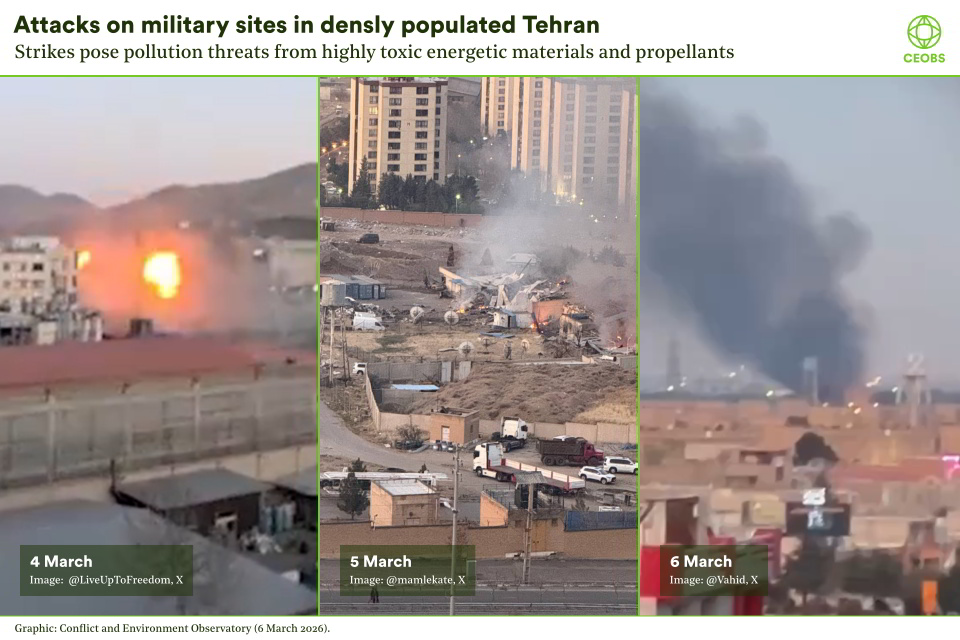
Damaged missile facilities are a particular concern. Iran operates both solid- and liquid-fuelled ballistic missiles, and some liquid propellants — such as unsymmetrical dimethylhydrazine and inhibited red fuming nitric acid used in SCUD-type systems — are highly toxic and have posed serious management and disposal challenges in other conflict settings. Impacted sites include the well-known Tabriz and Zanjan military bases in northwestern Iran, as well as the Khojir missile production complex to the east of Tehran. Large smoke plumes were visible from each facility, and satellite imagery shows collapsed tunnels at various entry points in Tabriz.
Depots storing conventional weapons also pose environmental risks when attacked. The incomplete destruction of munitions can leave areas contaminated with heavy metals, propellants and explosives, many of which are toxic,3 while fires can create dioxins, furans and release particulate matter.
1.2 Marine pollution
Numerous incidents have now occurred along the coastline of the Persian Gulf. Although the Gulf is an area dominated by the fossil fuel industry — and its related pollution problems — there still exist pockets of ecologically important areas. These have been harmed in previous wars.
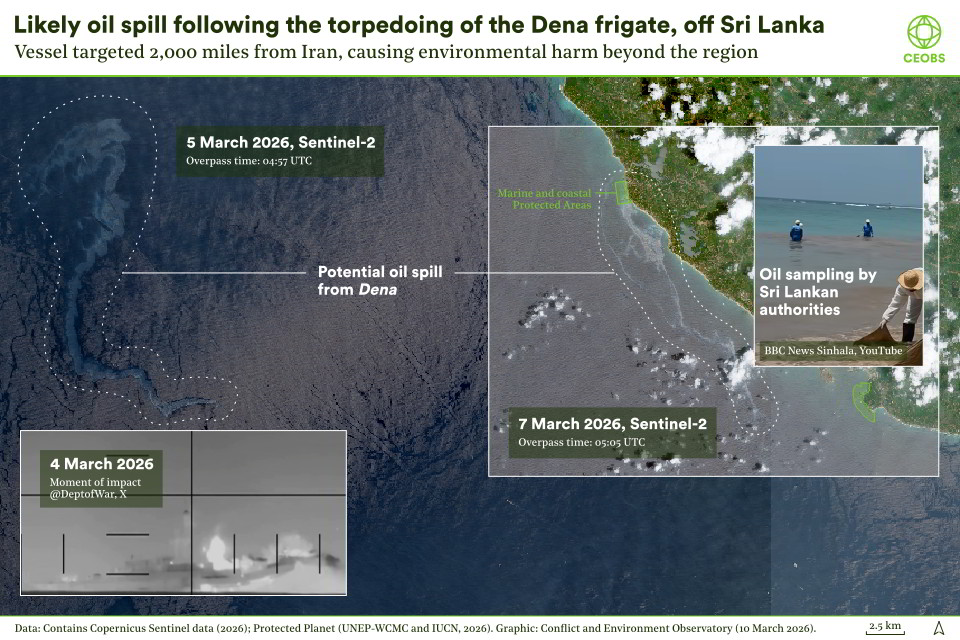
The US stated its intention to “annihilate” Iran’s navy and at the time of writing, may have damaged or sunk more than 43 vessels and attacked military port infrastructure at locations around Bandar Abbas and Konarak. Risks extend beyond the region: the Iranian frigate Dena was torpedoed close to the coast of Sri Lanka and a resulting 20 km long oil slick now threatens ecologically important areas along its coast. The Sri Lankan authorities are now undertaking clean-up and sampling.
Iran has also targeted civilian and military port infrastructure in Abu Dhabi, Dubai, Jabal Ali and Manama. Sunken vessels and damaged port infrastructure can present significant pollution risks, including from fuels and oils. Widespread electromagnetic jamming in the Gulf has further heightened risks, with vessels’ communication and navigation disrupted they are at more risk of collision.
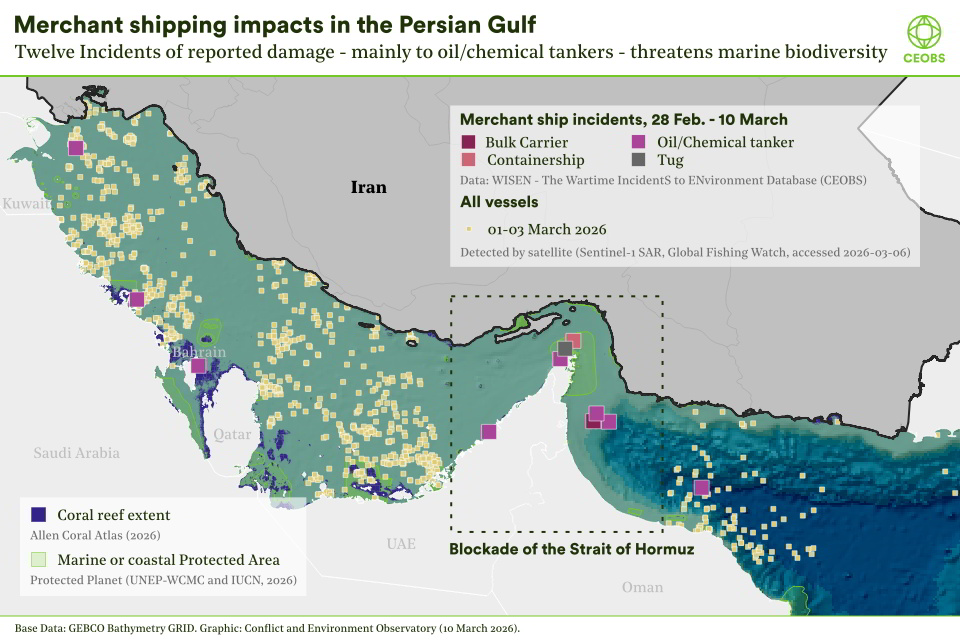
Attacks at sea carry serious oil spill risks, especially where conflict conditions limit emergency response capacity. So far, we have seen at least 12 merchant ships struck in ports or in the Persian Gulf — as the number of attacks grows, so the risks of a serious environmental incident rise.
1.3 Fossil energy infrastructure incidents
Iran and the Gulf control a substantial share of global oil and gas production, and facilities producing, refining, storing and exporting these fossil fuels have been the focus of attacks. These carry significant environmental risks through spills, fires and disrupted operations.
Israeli attacks on four oil facilities in and around Tehran on the weekend of the 7-8th March captured global attention on the environmental implications of the war after the city’s nine million residents were exposed to dangerous pollution levels, including “black rain” as soot and pollutants rained out of the smoke clouds. The attacks were part of a decision by Israel to attack around 30 oil processing and storage facilities across Iran. The attacks helped spook global oil markets and were criticised by the Trump administration. Our detailed assessment of the health and environmental costs of the Tehran strikes can be found here.
Other serious incidents occurred at Saudi Arabia’s Ras Tanurah refinery on the 2nd of March, and the UAE’s Fujairah Port on the 3rd. Both incidents were reportedly caused by Iranian drones, as a result of reported direct strikes and intercepted strikes respectively, and generated large smoke plumes. Such plumes can contain particulate matter, nitrogen oxides, sulphur dioxide, carbon monoxide and toxic organic compounds — including PAHs and potentially dioxins — posing health risks to downwind communities. Blackouts following attacks on energy infrastructure, such as in Ras Laffan Industrial City in Qatar, can cause significant secondary harm, with power loss disrupting safety systems and triggering industrial pollution.
Risks to shipping associated with the conflict increased the cost of vessel insurance, effectively creating a blockade of the Strait of Hormuz which has been reinforced by Iranian military threats and sporadic attacks on shipping. By the 9th of March only ships with Iranian connections were reported to be passing. At the outset of the war roughly 150 crude and LNG tankers were anchored in the Gulf, meaning the oil, gas and global urea trade will face severe disruptions. While Saudi Arabia is redirecting some exports via the Red Sea, many Gulf countries are reducing production.
Qatar has shut down Liquefied natural gas (LNG) production, which may take months to restore to full capacity, and has warned that they may be forced to halt energy exports entirely, with energy production in Iraq, Israel and now Kuwait also impacted. This has contributed to an energy price shock that — if prolonged — will have complex downstream effects for both the region and the international community. Following Russia’s full-scale invasion of Ukraine, higher energy prices led to a shift to more polluting fuels in the short-term in Europe but has contributed towards policies supporting the energy transition in the medium term. For countries like Iraq whose economies are highly dependent on fossil fuel rents, sudden drops in revenue can be politically destabilising. The Trump administration’s move to calm energy markets on the 9th March led to initial reductions in oil prices. The overall picture for global greenhouse emissions will take time to become clear as it takes a substantial rise in oil prices to dampen demand.

2. Potential environmental threats
2.1 Nuclear facilities
Although “failed” negotiations over Iran’s nuclear programme were used as a pretext for launching the conflict, so far the extent of attacks on Iran’s nuclear facilities appears limited. Certainly they are not on the scale of those seen during the 12 Day War in 2025, suggesting that the previous US and Israeli bombing campaign had already damaged or disabled many of them.
Iran’s Natanz enrichment plant was targeted on March 2nd. While the IAEA initially said it had no evidence of strikes on nuclear facilities on Monday, online analysts pointed to minor visible damage on satellite imagery, with the IAEA later confirming “damage to [the] entrance buildings of Iran’s underground Natanz Fuel Enrichment Plant”. No radioactive release was anticipated. Earlier that day the IAEA’s Director General had warned of the risks from nuclear sites across the region, which include power plants and research reactors in many of the countries that have been subject to attack.
The uncertainty surrounding events at Natanz reflects the difficulty of assessing the ongoing risks from Iran’s nuclear facilities. With IAEA inspections restricted since last year, the scale of any damage and Iran’s restored capacity remain unknown. Given the pace of events, further strikes are possible. On Tuesday, the IDF attacked what they claimed to be a nuclear facility approximately 5 km north-east of Tehran used to ‘develop the capabilities required for nuclear weapons’. Even partially operational facilities pose environmental risks. Other known major enrichment sites are located at Isfahan and Fordow, around 100 km south of Tehran.
2.2 Desalination plants
Around 450 desalination plants provide drinking water to ~100 million people across the Gulf. On the 7th October Iran accused the US of attacking a desalination plant on its Qeshm Island, affecting the water supply for 30 villages. The following day Bahrain accused Iran of damaging a plant in a drone strike.
Damage to desalination plants has the potential to cause environmental harm: chemicals used in the desalination process including sodium hypochlorite, ferric chloride and sulfuric acid. The plants routinely discharge hypersaline water into the Gulf, and discharges already put pressure on the coastal and marine environments. Plants can also be impacted by de-energisation events.
Desalination plants are indispensable to the wellbeing of the civilian population and any decision to draw them into the war would mean that an important threshold had been crossed. Any committed campaign against them could lead to human displacement, in turn generating reverberating consequences for the environment.
2.3 Weakened environmental governance
Environmental governance was already weak in Iran. Nationally, pressures included biodiversity loss, land degradation and oil pollution, with water governance particularly weak. Armed conflicts and their aftermath are frequently associated with periods of weak governance. Environmental ministries are typically under-resourced, while environmental protection is underprioritised in the transitions from war to peace. This can translate into serious environmental and natural resource degradation at the national level, and at distance from the direct effects of warfare.
A Bellingcat report suggests that the US and Israel are targeting strikes on Iran’s police infrastructure as a component of the regime that they have pledged to dismantle. There is little to suggest a plan for what comes afterwards, what a future government could look like and how governance could be restored. In the event that the regime remains in place it may well be more hardline than that which preceded it. Environmental civil society already faced serious constraints in its activities and these may become more pronounced. This would also be the case in the event that the Iranian state fragmented.
After the 12 Day War in 2025 the Iranian regime elected not to strategically highlight the environmental costs of the war, in spite of a clear external propaganda benefit in doing so. The position may reflect domestic sensitivity over acknowledging both the extent of the damage to facilities and the consequences of any associated environmental harm, and its capacity or willingness to deal with it. This position tracks Iranian government policy on domestic environmental issues but it also means that harm is less likely to be addressed, with implications for public health and ecosystems.
3. Continuing to track harm
Continued monitoring is essential to ensure environmental harm is mapped and communicated. Doing so allows us to identify health risks, helps inform clean-up and recovery, and can be used to pursue accountability.
On the 9th of March, the Trump administration indicated that the war may soon draw to a close. A move designed to calm the global energy markets, the administration’s shifting aims in this war allow some freedom to declare victory under any conditions but the picture on the ground may remain different. Importantly, the US decision may not cover the activities of Israel, and as the situation in Gaza has demonstrated, attacks and ceasefire breaches may continue long after the US’s attention has shifted elsewhere.
We have launched a full WISEN — Wartime IncidentS to ENvironment Database — for this conflict. This follows the successful template of our WISEN-Ukraine database, which we have been populating over the past four years and whose results will soon be published.
In addition to the basic incident analysis presented here, WISEN-Ukraine also incorporates detailed documentation and impact assessments, as well as simple facility damage based only on satellite data, where no footage is available. To meet our ambition, we will work with others in this space — in particular partners in the Decentralized Damage Mapping Group — and are also seeking funding to support our expert CEOBS researchers. We welcome conversations with donors wishing to support these activities.
This assessment was put together by the CEOBS team. We need your financial support to continue our work.
- An instance that has or may result in substantial pollution, environmental health impacts, a pause/stop of ecosystem/environmental services, contribute to climate or biodiversity breakdown, or a combination of any or all of these.
- Incidents with a high environmental risk score are those facilities with a high risk profile, for example that store toxic chemicals, which are in proximity to dense populations or vulnerable environments, and where the magnitude of the incident was high.
- TNT (2,4,6-trinitrotoluene) is used as a booster for high-explosive munitions and is highly chemically stable. This means it can remain in the soil even as UXO casings degrade, having long-term vegetation and human health impacts – high concentrations are still found at WWI battle sites. The US EPA classifies TNT as a possible human carcinogen, and exposure to even low concentrations can lead to long term health impacts including abnormal liver function and anaemia. Exposure is typically through drinking contaminated water – the level of groundwater contamination is more significant in sandy soils, whereas in high carbon soils TNT rapidly degrades and so is largely contained to the site of contamination. However, this chemical and microbiological decomposition can produce harmful derivatives, in particular DNT (2,4-dinitrotoluene). DNT is highly toxic, more so than TNT itself, and is listed by the US EPA as a priority pollutant in aquatic environments. RDX, Royal Demolition Explosive (hexahydro-1,3,5-trinitro-1,3,5-triazine) is another chemically and thermally stable compound. It is both less soluble and susceptible to degradation than TNT, and this makes it more likely to migrate through soils and contaminate groundwater. Plants, including crops, take up RDX, yet because they cannot naturally degrade it, they become a potential contaminant redistribution source. This can be through fire, cuttings, or by being eaten – RDX can then start to bioaccumulate in the food chain, posing risks to wildlife and humans. Results from liver and lung animal studies suggest RDX is potentially carcinogenic, though there is no data for humans. It can be toxic when ingested. Structurally similar to RDX is HMX, High Melting Explosive (octahydro-1,3,5,7-tetranitro-1,3,5,7-tetrazocine), which is used in artillery shells and plastic explosives. It is even less soluble, though is also less toxic in the environment.