
Three days of Operation Epic Fury: a rapid overview of environmental harm in Iran and the region
Published: March, 2026 · Categories: Publications

A rapid overview of emerging environmental issues and risks in Iran and the wider region from Operation Epic Fury. Three days in and we’re already seeing pollution incidents that are placing people and ecosystems at risk of acute and chronic harm, as well as trends that could lead to substantial environmental harm as the war continues.
Overview
To understand the nature and scale of environmental harm CEOBS has been identifying incidents of environmental harm and undertaking a basic risk assessment for each.1 We have searched social and traditional media for incidents and then undertaken a verification and remote environmental assessment using additional social and traditional media footage triaged with satellite imagery.
So far we have identified 120 incidents, 92 of which have been assessed for their environmental risk. The results are mapped in Figure 1 below, showing incidents in Iran, Iraq, Israel, Kuwait, Jordan, Cyprus, Bahrain, Qatar, the UAE, Saudi Arabia and Oman. By far the commonest facility type is a ‘Military Object’ (56), and of those the most impacted sub-type is ‘Airbases’ (12). Away from military sites, incidents cover a range of facility types, with different pollution profiles, from hospitals, to tyre storage sites, to oil refineries.
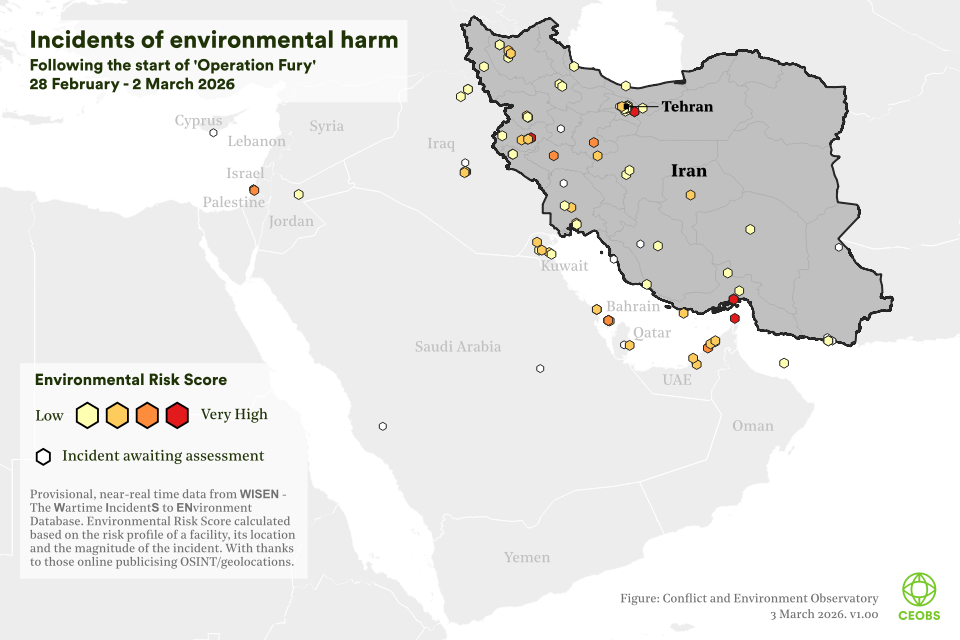
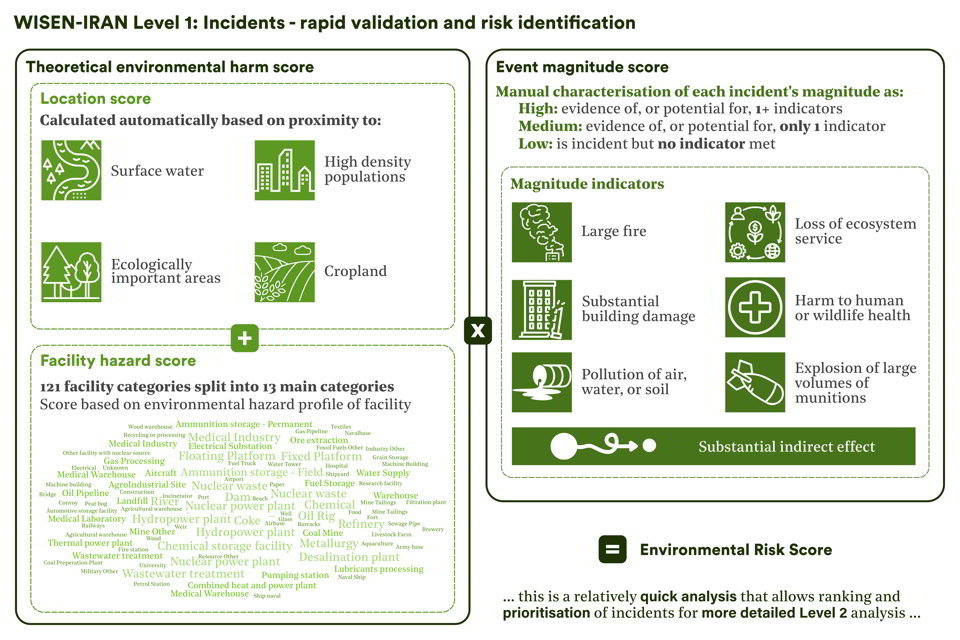
Incidents with a high environmental risk score are those facilities with a high risk profile, for example that store toxic chemicals, which are in proximity to dense populations or vulnerable environments, and where the magnitude of the incident was high.
Health warning: incidents are based largely on social media monitoring and though this has been vetted, incidents require a more comprehensive verification and peer-review, which will also more fully reveal their environmental impacts. There will also be many more incidents to retrospectively add to catch up with the high speed of conflict events, geographic span and chaotic online information space.
Based on our incident assessment, we now brief on four key emerging trends of environmental harm, many of these touch on issues identified in our rapid assessment of the 12 Day War in 2025.
Pollution from military sites and materiel
The majority of reported US and Israeli strikes during ‘Operation Epic Fury’ have targeted missile bases, airfields, weapons depots and military production facilities across Iran. Iran has responded by striking US air and naval bases in Kuwait, Qatar, Bahrain and the UAE, while US Defense Secretary Pete Hegseth has indicated efforts will continue to curb Iran’s ability to “project power” through missiles, drones and naval assets. Israel has also conducted dozens of strikes in Lebanon on alleged weapons depots and launch sites.
Although many attacked sites show secondary explosions and fires, these rarely destroy all hazardous materials and may generate additional pollution. Likely contaminants include fuels, oils, heavy metals, energetic compounds and PFAS, while fires can release dioxins and furans. Many Iranian military facilities are in rural areas, complicating damage assessment and potentially reducing human exposure risks, but several sites across Iran, Lebanon and the Gulf lie near cities, increasing public exposure risks if pollutants spread. Pollution may also persist or worsen if sites are repurposed over time.
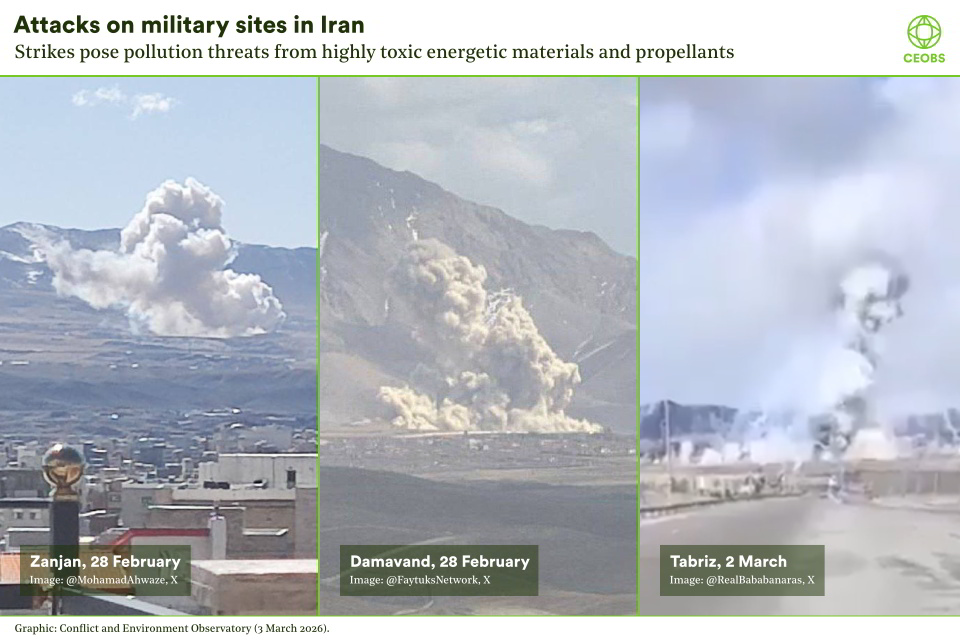
Damaged missile facilities are a particular concern. Iran operates both solid- and liquid-fuelled ballistic missiles, and some liquid propellants — such as unsymmetrical dimethylhydrazine and inhibited red fuming nitric acid used in SCUD-type systems — are highly toxic and have posed serious management and disposal challenges in other conflict settings. Impacted sites include the well-known Tabriz missile base and Zanjan military base, in northwestern Iran. Large smoke plumes were visible from both facilities, and satellite imagery shows collapsed tunnels at various entry points in Tabriz.
Marine pollution
Multiple incidents have occurred in or along the coast of the Persian Gulf. Though the Gulf is an area dominated by the fossil fuel industry — and its related pollution problems — there still exist pockets of ecologically important areas. These have been harmed in previous wars.
The US stated its intention to “annihilate” Iran’s navy and at the time of writing may have damaged or sunk 11 vessels and attacked military port infrastructure at locations around Bandar Abbas and Konarak. Iran has also targeted civilian and military port infrastructure in Abu Dhabi, Dubai, Jabal Ali and Manama. Sunken vessels and damaged port infrastructure can present significant pollution risks, including from fuels and oils. Reports of an attack on a UAE owned oil platform remain unconfirmed. Widespread electromagnetic jamming has further heightened risks, with vessels’ communication and navigation disrupted.
Attacks at sea carry acute oil spill risks, especially where conflict conditions limit emergency response capacity. We are awaiting satellite imagery to determine whether the following five targeted tankers have released oil:
- MKD VYOM, a 273 m laden crude oil tanker, struck by a naval drone. It is currently 50 nautical miles off the coast of Muscat, Oman.
- STENA IMPERATIVE, a US-flagged oil tanker, attacked twice while at port in Bahrain, triggering a fire.
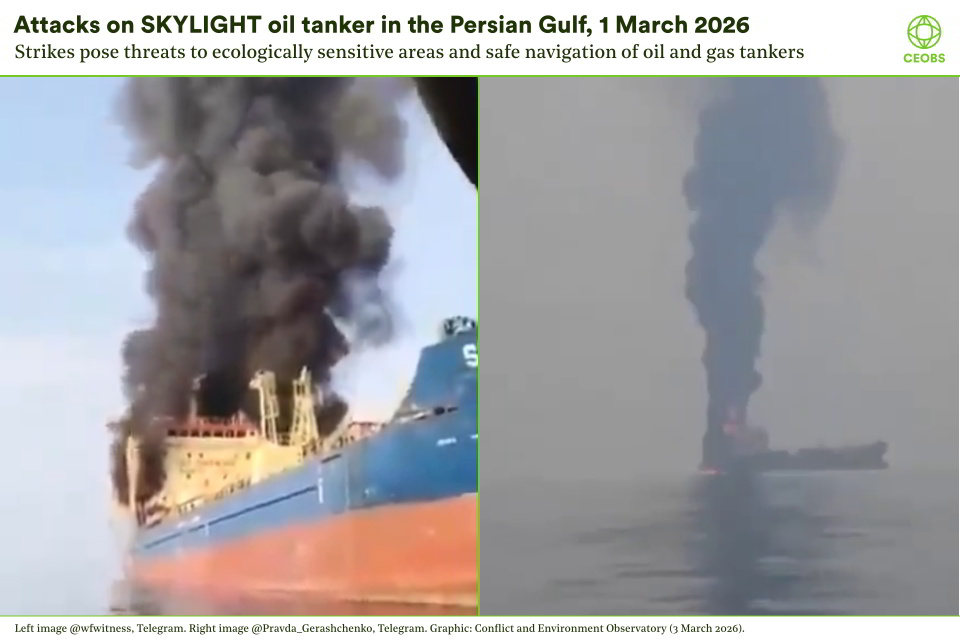
- SKYLIGHT, a sanctioned oil and chemical tanker set alight following a naval drone attack in the Musandam governorate of Oman. The SKYLIGHT is considered an Iranian ‘shadow vessel’, yet is thought to have been attacked by Iran, potentially as a means of increasing the perception of conflict risks for vessel owners and insurers.
- OCEAN ELECTRA, oil tanker reportedly struck by a drone, though without significant damage.
- HERCULES STAR, a 115 m crude oil tanker reportedly struck 17 nautical miles northwest of Mina Saqr, UAE, causing a fire.
Despite Iranian requests, so far there have been no reports of attacks in the Red Sea or Bab al-Mandab Strait by Houthi forces. If vessel strikes are renewed, there are significant pollution risks in open waters, but also to coastal areas following reprisal attacks, as previously occurred in Hodiedah.
Fossil energy infrastructure incidents
Iran and the Gulf control a substantial share of global oil and gas production, and facilities producing, refining, storing and exporting these fossil fuels have been the focus of attacks. These carry significant environmental risks through spills, fires and disrupted operations.
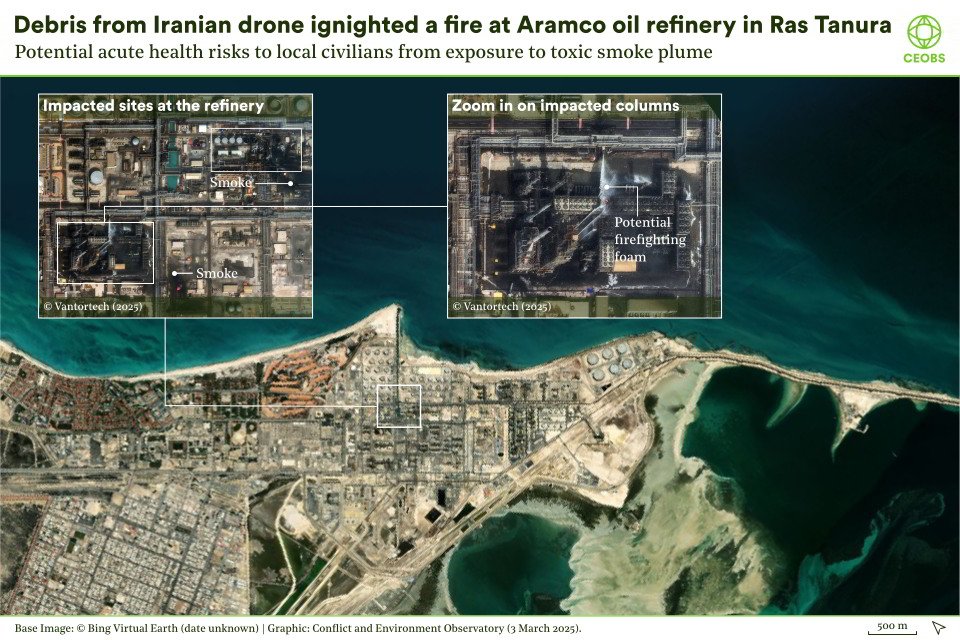
A drone strike at Saudi Arabia’s Ras Tanurah oil refinery triggered a fire and a large smoke plume. Such plumes can contain particulate matter, nitrogen oxides, sulphur dioxide, carbon monoxide and toxic organic compounds — including PAHs and potentially dioxins — posing health risks to downwind communities.
Blackouts following attacks on energy infrastructure, such as in Ras Laffan Industrial City in Qatar, can cause significant secondary harm, with power loss disrupting safety systems and triggering industrial pollution.
There are also consequences for the global environment through changes in greenhouse gas emissions. Attacks on oil and gas sites will release methane, carbon dioxide and other greenhouse gasses, but the curtailment of production — as has occurred with Qatari LNG, oil production in Iraqi Kurdistan and Israeli offshore gas — does not necessarily reduce emissions. Instead energy price signals can lead to short term substitution, as well as more complex downstream energy supply changes over longer timeframes.
Risks to shipping associated with the conflict have increased the cost of vessel insurance, effectively creating a blockade of the Strait of Hormuz, cutting traffic by 80%. With roughly 150 crude and LNG tankers anchored in the Gulf, the oil, gas and global urea trade will face severe disruptions, potentially reducing emissions in the short term.
Nuclear facilities
Although “failed” negotiations over Iran’s nuclear programme were used as a pretext for launching the conflict, so far the extent of attacks on Iran’s nuclear facilities appears limited. Certainly they are not on the scale of those seen during the 12 Day War in 2025, suggesting that the previous US and Israeli bombing campaign had already damaged or disabled many of them.
Iran’s Natanz enrichment plant was targeted on March 2nd. While the IAEA initially said it had no evidence of strikes on nuclear facilities on Monday, online analysts pointed to minor visible damage on satellite imagery, with the IAEA later confirming “damage to [the] entrance buildings of Iran’s underground Natanz Fuel Enrichment Plant”. No radioactive release was anticipated. Earlier that day the IAEA’s Director General had warned of the risks from nuclear sites across the region, which include power plants and research reactors in many of the countries that have been subject to attack.
The uncertainty surrounding events at Natanz reflects the difficulty of assessing the ongoing risks from Iran’s nuclear facilities. With IAEA inspections restricted since last year, the scale of any damage and Iran’s restored capacity remain unknown. Given the pace of events, further strikes are possible. Even partially operational facilities pose environmental risks. Beyond Natanz, major enrichment sites are located at Isfahan and Fordow, around 100 km south of Tehran.
Continuing to track harm
It is essential to continue monitoring to ensure environmental harm is mapped and communicated. Doing so allows us to identify health risks, helps inform clean-up and recovery, and can be used to pursue accountability. Additional types of harm that may emerge as the conflict progresses include the targeting of water, sanitation and health (WASH) infrastructure, cyberattacks on industrial facilities, the impact of ballistic missiles in the upper atmosphere, and the increasing use of attritional, single use drones.
Our intention is to launch a full WISEN — Wartime IncidentS to ENvironment Database — for this conflict. This will follow the successful template of our WISEN-Ukraine database, which we have been populating over the past four years and whose results will soon be published.
In addition to the basic incident analysis presented here, WISEN-Ukraine also incorporates detailed documentation and impact assessments, as well as simple facility damage based only on satellite data, where no footage is available. To meet our ambition, we will work with others in this space — in particular partners in the Decentralized Damage Mapping Group — and are also seeking funding to support our expert CEOBS researchers. We welcome conversations with donors wishing to support these activities.
This post was researched and written by the CEOBS team. If you find our work useful, please consider a donation so that we can continue it.