Belligerents argue that attacks on oil facilities are militarily legitimate but in Tehran the civilian impact has been huge.
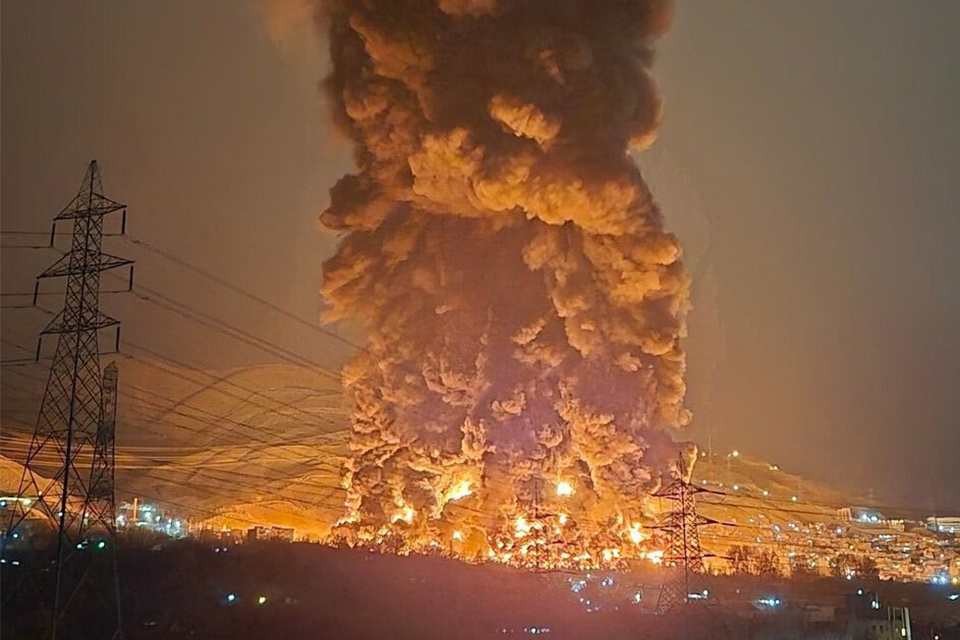
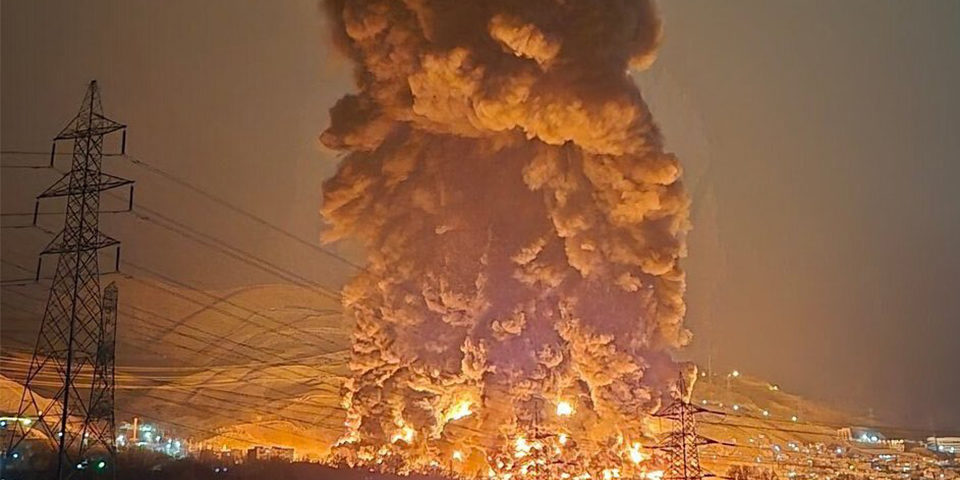
Israeli attacks on four oil facilities in Tehran have exposed millions of Iranians to harm. In this post we explore the attacks and unpack the health and environmental risks faced by the civilian population.
Introduction
Overnight on the 7-8th of March, the Israeli-US war against Iran saw a significant escalation as Israel targeted Iran’s oil infrastructure. Israel reportedly attacked more than 30 oil facilities, which it claimed were being used for “military purposes.” The US subsequently distanced itself from the strikes, questioning both their scale and strategic rationale.
Tehran was heavily affected, resulting in a major environmental incident. Footage showed thick plumes of black toxic smoke and large fires burning at several facilities. This toxic mix of pollutants subsequently rained out over the city and entered drainage systems, raising concerns about possible surface and groundwater contamination. With a population of more than nine million, the incident raises serious acute and long-term health concerns for Tehran’s residents.
Four sites were targeted in and around Tehran, including the Aqdasieh oil depot in Tehran’s northeast, the Shahran oil facility in the north of the city, and the Karaj oil depot in the city of Karaj to the west of Tehran. The Tehran oil refinery was also targeted. The refinery has the capacity to process approximately 225,000 barrels of oil per day and is among the larger refining facilities in Iran. It produces a range of products, with its main focus on LPG and gasoline, but it also specialises in sulphur recovery and vacuum bottoms, a heavy material used in tarmac.
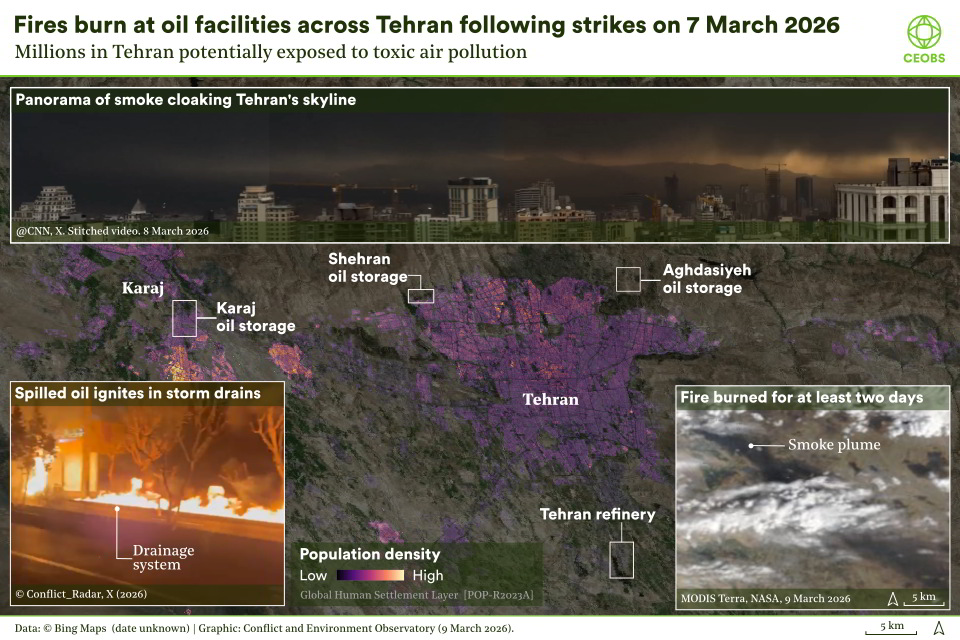
Due to the ongoing war, it is unlikely that the fires will be extinguished quickly: 72 hours later only the Karaj oil depot fire appears to be extinguished.1 The Tehran attacks were just some of the sites targeted nationwide over the weekend, which marked the most significant attack on Iran’s civilian industrial and energy infrastructure since the beginning of the conflict.
Acute health risks
Iranians on social media described the ensuing oil fires as ‘hellscapes’, ‘a black monster’, and ‘apocalyptic’; a mark of their psychological impact. But what of their acute physical health impact? While the health impacts of long-term exposure to air pollution are relatively well established, the literature on acute exposure for similar events is limited. Even less so on the compound effects of such exposures and those from other conflict pollutants such as pulverised building materials dispersed by blasts. Nonetheless, health impacts will be informed by the smoke composition, concentration, exposure pathways and comorbidities, which we explore below.
Smoke composition
Smoke from oil or refinery fires is a complex mixture of gases and particles produced by incomplete combustion of hydrocarbons and industrial materials.2 Typical pollutants include carbon monoxide, sulphur dioxide, nitrogen oxides and volatile organic compounds (VOCs), alongside particles composed of soot, organic material and trace metals.
It is often difficult to attribute symptoms in a specific event to any one component of the smoke mixture with confidence, but we know one particle of particular concern is black carbon, a near-pure carbonaceous component of soot produced during incomplete combustion. Acute exposure can lead to respiratory disorders, particularly for high-risk groups like those with asthma and the elderly. The very small black carbon particles can penetrate deep into the lungs and can also carry other toxic pollutants on their surfaces, including polycyclic aromatic hydrocarbons (PAHs). Trace metals that occur naturally in crude oils are also of concern, such as nickel and vanadium, which cause respiratory irritation and inflammatory effects.
Reports out of Tehran describe “toxic acid rain”. This phenomenon is caused by the combustion of sulphur rich “sour” crude oil when sulphur dioxide gas is emitted into the atmosphere, turning into sulphuric acid in raindrops. Depending on concentration, sulphuric acid exposure can irritate the eyes and respiratory tract, but in practice it is often difficult to separate those effects from the wider impacts of soot, acidic gases and other potential combustion products like dioxins and furans, which act together rather than in isolation.
Smoke concentration
People in Tehran will have exposure to different pollutant concentrations based on their proximity to the fires, their local built environment, their building construction, how long they spent outside, and the weather.
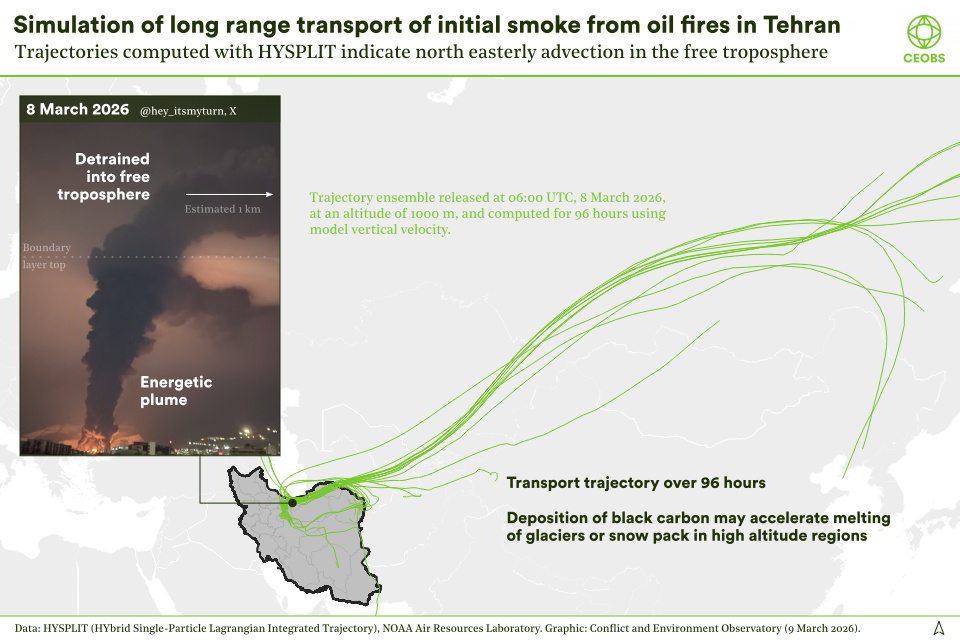
In the early stages of the oil fires, large energetic plumes thrust the majority of the pollution up high, and away from people near the ground. These towering plumes punctured the planetary boundary layer,3 with smoke exported away (see below). However, as the fires lost energy, the plumes lowered and all smoke was within the boundary layer. This is particularly problematic in Tehran, owing to the local geography.
Tehran lies on the southern foothills of the Alborz Mountains in a semi-enclosed basin where surrounding peaks rise to 2-4 km, strongly restricting air circulation over the city. In winter and early spring the daytime boundary layer typically reaches only around 1-1.5 km, far below the surrounding mountain crest heights, forming a temperature inversion that acts as a cap to trap pollutants. What’s more, after sunset the boundary layer collapses to a few hundred metres, which concentrates pollutants near the ground. This effect produces the highest pollution levels overnight and in the early morning, until the boundary later starts to rise as the sun warms the ground.
At the street scale, Tehran’s dense urban fabric creates numerous “urban canyons” where rows of mid- and high-rise buildings can restrict airflow, creating concentration hotspots. Modelling studies show that these can generate recirculating vortices that trap pollutants at pedestrian level, further reducing ventilation even when air above the rooftops is moving.
Given its slack winds, Tehran needs significant rain to ‘clean’ the air to remove the particles and gases most hazardous to human health. No direct observations are available due to the black-out, while weather forecast models indicate the rainfall so far has been limited, satellite observations do suggest some rainfall – the so called “acid rain”. However, the fires still burn – and so the toxic smoke has continued to accumulate within the boundary layer.
Staying inside doesn’t fully eliminate exposure. One study in Tehran showed that outdoor particulate pollution readily infiltrated residential buildings — which often rely on natural ventilation and have relatively leaky building envelopes — meaning indoor particle concentrations frequently track outdoor levels during severe pollution episodes. This indoor pollution will persist for hours or days, with fine particles deposited on furnishings, potentially prolonging exposure, especially if cleaning is not possible due to the war and water availability.
Elements of the smoke pollution will have been deposited onto Tehran’s urban fabric — its roads, roofs, soils and croplands — where they can accumulate. This can act as a source of secondary exposure, for example when winds resuspended the pollution back into the air. This may be a particular issue in the dry summer months when Tehran experiences dust storms.
Population vulnerability
Acute air pollution episodes disproportionately affect people with existing health conditions. Individuals with asthma, chronic obstructive pulmonary disease (COPD), cardiovascular disease and diabetes are consistently identified as being at greater risk during short-term spikes in particulate pollution. Studies of wildfire smoke — a useful analogue — show same-day increases in respiratory emergency visits, hospital admissions and mortality, particularly among older adults and those with underlying respiratory or cardiovascular disease.
In Tehran these risks may be compounded by the city’s high baseline pollution, where average PM₂.₅ levels exceed WHO guidelines by up to 4.5 times. Chronic exposure can leave residents with airway or cardiovascular stress, increasing the likelihood that acute smoke exposure triggers exacerbations of asthma, COPD and cardiac events.
Reverberating environmental impacts
Water pollution
There are reports that spillages from the Shahran oil storage site entered the storm drains in Tehran and explosively ignited. Tehran has a large and complex network of storm drains to carry runoff from rainfall and snowmelt off the surrounding mountains. It is difficult to forecast exactly where spilled oil products — or the deposited contaminates that were later washed into the storm drains — may be discharged. However, it would be expected to follow Tehran’s north-to-south slope and may enter natural water bodies or agricultural soils, where in turn shallow groundwater could become contaminated.
Long-range transport of smoke
As well as exposing the people of Tehran to harm, the smoke has also been transported and deposited more widely. This may affect urban areas, crops, and ecology far from the city, and of course tens of other sites have also been targeted. We can track this through media reports — such as a citizen about 70 miles north of Tehran reporting black soot on his recently washed car — but also by simulating the pollution transport with models.
Using the HYSPLIT atmospheric model we can track where smoke released above the boundary layer may end up, based on the forecast winds and atmospheric motions. The trajectories indicate the airmass will travel in a north-easterly direction: one high-altitude area at risk of deposited soot may be the Golden Mountains of Altai in Siberia, home to several glaciers. HYSPLIT is a simple representation of the atmosphere; more complex models — such as those with chemistry, street canyon effects, or exposure/inhalation dose — can and should be used to better understand the environmental harms and public health risks.
Climate
Fires at oil storage or refinery infrastructure release carbon primarily as carbon dioxide — though this would have been emitted eventually anyway when oil products were burned. However, uncontrolled combustion — especially when smouldering — may lead to relatively more emissions of methane, whilst ground-level ozone (another greenhouse gas) may be produced downwind.
Furthermore, oil burnt in this way produces relatively more emissions of short-lived climate forcers: black carbon absorbs and warms the atmosphere, whereas organic and sulphate aerosols scatter and cool. This may be particularly important when these particulates are injected into the upper atmosphere, where they persist longer. Here, they can exert stronger short-term climate effects, or be transported to glaciers where black carbon can accelerate warming, as happened with the Kuwait oil fires of 1991. Alterernatively, these particulates may interact with clouds, changing their lifetime and structure – thus their instantaneous climate forcing. If the number of oil fires in the region increases, then cumulatively these effects may have an appreciable effect on climate meaning that observation and tracking is important.
Law and the acceptability of attacks on oil sites
Attacks on oil infrastructure are commonplace in conflicts and usually justified by belligerents on the basis that facilities contribute to the war effort through the provision of fuel, as well as economically. Facilities are also a common target of non-state armed groups: in Iraq Daesh targeted oil wells because of their psychological effect on the local community, effectively using the fires as a weapon of war. Major incidents affecting oil facilities have also proved a trigger for the development of international policies seeking to enhance the protection of the environment in relation to armed conflicts.
Israel’s decision to attack around 30 oil facilities over the weekend appears to have alarmed the US, with concerns expressed over the political impact of oil price rises. While these were not production sites, the US was concerned about the optics; oil fires grab the media attention. Iran’s attack on a refinery in Bahrain on the 9th will have done little to quell fears that the sector will not become collateral damage as the war continues.
Beyond the global markets, the nationwide attacks will have an impact on civilian lives and wellbeing, as well as on the environment, public health and climate. Notably, and as discussed above, major fires can impact the environment over substantial geographic areas and cause long-lasting harm, be it soil and water pollution, or greenhouse gas emissions. In the specific case of the Tehran facilities, it is highly unusual for this many sites to be attacked in such a densely populated area that is so geographically vulnerable to poor air quality, leading to so many people being exposed to a dangerous mixture of pollutants. These factors should have influenced Israel’s legal and military calculus, if the protection of civilians was being viewed as a priority.
This post was researched and written by the CEOBS team. If you find our work useful, please consider a donation so that we can continue it.
- Fire detections using FIRMS, the Fire Information for Resource Management System.
- Many compounds are also semi-volatile, meaning they can move between gas and particle phases as the plume cools and reacts chemically while travelling downwind.
- The planetary boundary layer is the lowest part of the atmosphere where air is directly influenced by the Earth’s surface, and its height changes through the day as sunlight warms the ground and drives convection and mixing (raising it), while night-time cooling stabilises the air and causes it to shrink.