
Militaries and conflict: critical gaps in climate action
Analysing how governments address military emissions and conflict impacts in UNFCCC Nationally Determined Contributions: the climate action plans that set out how emissions will be reduced and how countries will adapt to climate risks.
Published: October, 2026 · Categories: Publications, Military Emissions Gap

Key findings
Military emissions
- Military emissions data is consistently missing from countries’ emissions reporting, representing a key emissions data gap from a high-contributing sector of the economy.
- In estimations and reporting outside UNFCCC processes, military emissions are calculated to represent a large share of global emissions.
- Very few countries effectively report on their military emissions nor account for them in their emissions reduction planning in their Nationally Determined Contributions (NDCs).
- None of the NDCs of the world’s largest military spenders, including the US, China and Russia, contain relevant mentions of militaries.
- No government has made an explicit commitment to reduce military greenhouse gas emissions within its NDC, despite net zero commitments elsewhere.
- Countries are unlikely to realistically achieve their net zero ambitions and keep under 1.5 and 2C targets, if military emissions are not included in emission reduction targets.
Conflict and climate impacts
- Armed conflict is increasingly recognised as a barrier to climate mitigation and adaptation, however countries rarely connect conflict with the emissions generated by militaries themselves.
- However, in the most recent NDCs some countries explicitly reference the impact conflict can have on climate mitigation and adaptation plans, including the impact of the destruction of carbon sinks.
- Given the damage that can result from conflict, this report recommends viewing peacebuilding and conflict prevention as another dimension of climate action.
Contents
Introduction
Nationally Determined Contributions (NDCs) are the official national climate plans of countries under the Paris Agreement. A country’s NDC outlines how it will cut greenhouse gas (GHG) emissions and adapt to climate change. Countries must review and update their NDCs every five years, with each government deciding its needs and targets based on its local circumstances and capabilities. The submission includes emission targets with specific goals to lower GHG emissions. The aim of NDCs is to keep global warming under the 1.5C target and track climate action by showing what each country commits to in the short and medium term. The most recent NDC submissions were in 2025, which is the third cycle of NDC submissions.
Recent research has highlighted the contribution of militaries to global emissions, with estimates suggesting that the everyday activity of the world’s militaries could be responsible for around 5.5% of global emissions, excluding the additional impact of conflicts. In comparison, another emissions intensive sector, global shipping, which has faced growing pressure to reduce emissions, is estimated to account for 3% of global emissions. In order to tackle climate change it’s important to account for emissions, however military emissions are frequently absent from global emissions reporting to the UNFCCC. Data gaps undermine efforts to identify and address emission hotspots when developing effective emissions reduction plans.
Armed conflict also impacts climate action, resulting in further consequences for people living in and outside of conflict zones. Studies have highlighted the emissions and climate impacts from recent conflicts. Russia’s invasion of Ukraine has emitted 311.4 m tonnes of carbon dioxide equivalent (CO2e) in the four years of fighting, roughly equal to the yearly emissions of France. The conflict emissions from the Israel-Gaza conflict from October 2023 to the January 2025 ceasefire have been estimated to have exceeded 30 m tonnes CO2e, roughly equivalent to the annual emissions of Jordan. Meanwhile conflict can impact countries’ ability to mitigate emissions and adapt to climate change through ecological harm, infrastructure damage and weakened institutions.
NDCs are one of the main mechanisms for states to report on their emission reduction plans and climate ambition, this report analyses the most recent NDCs in order to assess how militaries and conflicts are impacting climate action.
Method
This report’s main research question is whether governments acknowledge and include military emissions in climate reduction targets, and how conflict is acknowledged in its impact on national climate ambitions. To assess the extent to which militaries and conflict are addressed in national climate plans, an analysis was carried out of countries’ most recent NDCs, focusing on the latest round submitted from 2025 onwards, which set out countries’ targets up to 2035. NDCs were searched both directly, and by using Climate Policy Radar, for the terms: “military”, “conflict”, “security”, “defence”, “war”, “peace”.
The 31 NDCs that contained relevant mentions of these terms were then reviewed in more detail; notably 29 of the 31 were from non-Annex I countries. Not all mentions were substantive, with some NDCs only mentioning the terms briefly. The submissions and relating paragraphs were then recorded and classed according to how the paragraph discussed military or conflict relating to climate. The findings on military emissions are set out in section 1 and the findings on conflict in section 2.
1. Analysis of Nationally Determined Contributions: Military emissions
1.1 Data gaps and lack of accounting
Military emissions data is consistently missing from countries’ emissions reporting, representing a key data gap from an emissions intensive sector of the economy. In reporting to the UNFCCC, country submissions of their national emissions often omit, partially report or don’t disaggregate data on military emissions. This lack of reporting on a sector of the economy that is emissions intensive represents a key gap in accounting and data needed to adequately tackle climate change.1
At present no governments are obliged to report their military emissions. Military emissions reporting was excluded from the Kyoto Protocol, while the 2016 Paris Agreement made military emissions reporting voluntary. While some countries do provide a limited amount of data, only six countries reported their military emissions to a fair level at the last round of submissions. This means that there is a significant gap in the emissions data being reported, which obscures our true emissions and therefore the climate risks we may face as a result. However, many of those countries still show a significant gap compared to estimates of what the military emissions of that country are likely to be.
Table 1: Countries with a fair level of reporting (data from militaryemissions.org)
| Country name | Stationary emissions (as reported under 1A5a) MtCO2e | Mobile emissions (as reported under 1A5b) MtCO2e | Gap in emissions reporting | Data accessibility score | Military expenditure (2024), US$ millions | % of GDP |
|---|---|---|---|---|---|---|
| Bulgaria | 0.032 | 0.024 | Very significant gap in reporting. | Fair - data reported through the UNFCCC. | 2,192.70 | 1.93 |
| Cyprus | 0.02 | 0.003 | Very significant gap in reporting. | Fair - data reported through the UNFCCC. | 596 | 1.58 |
| Germany | 0.376 | 0.224 | Very significant gap in reporting. | Fair - data reported through the UNFCCC. | 86,148.30 | 1.84 |
| Hungary | 0.031 | 0.051 | Very significant gap in reporting. | Fair - data reported through the UNFCCC. | 4,732.70 | 2.12 |
| Norway | 0.000008 | 0.258 | Significant gap in reporting. | Fair - data reported through the UNFCCC. | 10,792.10 | 2.23 |
| Slovakia | 0.066 | 0.005 | Very significant gap in reporting. | Fair - data reported through the UNFCCC. | 2,786.50 | 1.98 |
However, many other countries do not report, partially report, or aggregate data with other civilian sectors such as aviation. These countries include some of the largest military spenders, such as the US, China, Russia and the UK. The top three spenders alone accounted for US$1,466 bn in military spending in 2024, more than half of the global total. Given the level of military expenditure, this lack of reporting represents a key gap in climate accountability for such large investments in a highly polluting sector.
Table 2: Top military spenders and UNFCCC military emissions reporting (data from militaryemissions.org)
| Country name | Total emissions (as reported under 1A5) MtCO2e | Gap in emissions reporting | Data accessibility score | Military expenditure (2024), US$ millions | Global military expenditure rank (2024) | % of GDP | Annex Type |
|---|---|---|---|---|---|---|---|
| United States | No report submitted | No comparison possible. | Very poor - no data reported through the UNFCCC. | 1,004,901.00 | 1 | 3.43 | Annex I |
| China | "Not occurring". | No comparison possible. | Very poor - no data reported through UNFCCC. | 311,900.40 | 2 | 1.66 | Non-Annex I |
| Russian Federation | 48.189 MtCO2e Stationary emissions (as reported under 1A5a). Mobile emissions (as reported under 1A5b) reported as: "Not occurring". "Included elsewhere". "Not applicable" | No comparison possible. | Poor - disaggregated data not reported through the UNFCCC. | 149,401.90 | 3 | 6.87 | Annex I |
| United Kingdom | "Included elsewhere" Stationary emissions (as reported under 1A5a). Mobile emissions (as reported under 1A5b) reported as: 1.148 MtCO2e | Very significant gap in reporting. | Poor - disaggregated data not reported through the UNFCCC. | 89,814.60 | 4 | 2.44 | Annex I |
| Germany | 0.376 MtCO2e, Stationary emissions (as reported under 1A5a). 0.224 MtCO2e, Mobile emissions (as reported under 1A5b) | Very significant gap in reporting. | Fair - data reported through the UNFCCC. | 86,148.30 | 5 | 1.84 | Annex I |
While this already represents a gap on what is reported on military emissions, it should be noted that under the UNFCCC’s voluntary guidelines, reporting only represents a subset of military emissions, and typically only covers energy use at military bases and fuel use from the operation of military equipment. Military emission sources are far broader than simply stationary and mobile fuel use, such as the use and disposal of munitions, waste management and disposal, and fugitive emissions from refrigeration, air conditioning, radar and electrical equipment; among other sources. In addition, military emissions in international waters or airspace need not be reported at all.
This means that even if all Annex I countries were to report in line with current UNFCCC guidelines, there would still be an emissions gap. Moreover, countries’ National Inventory Reports prepared for the UNFCCC only account for territorial emissions, meaning emissions generated beyond national borders are typically excluded. This approach creates grey areas in accountability, as emissions from overseas military operations or installations may fall outside the reporting scope of both the operating and host countries. Without coordinated data-sharing or clear guidance on attribution, these emissions remain unaccounted for within global inventories.
Some countries do publish national military emissions data outside of UNFCCC reporting, although it is rarely extensive. While this is welcome and provides some insight into the scale of military emissions, as well as potential target areas for mitigation, it should be noted that this type of reporting is not taken into account within UNFCCC reporting. A recent report from Scientists for Global Responsibility (SGR) found that data submitted to the UN on direct military emissions are around half the amount that is reported in national emissions reporting, with the data reported to the UN representing less than 10% of militaries’ estimated emissions, if a full scope accounting was done. And except in Norway’s case, this reporting often does not include many emission sources. The results of these reports show emissions from many militaries are large, and when wider emission sources are taken into account, these can represent more than 80% of a military’s emissions.
1.2 Military climate commitments
Nationally Determined Contributions
Despite the contribution of the military sector to global emissions, countries do not include any specific military-sector emission reduction plans or measures within their NDCs. Where militaries are mentioned in relation to emissions, it is mainly to note that they are excluded. For example Namibia and Nigeria note that sulphur hexafluoride (SF6) emissions from military use are not yet covered in their emissions inventories; SF6 is a potent GHG. In Namibia’s case the reason noted is due to a lack of good quality data. Lebanon was the only country to explicitly acknowledge climate harms from military activities, referencing the 2025 International Court of Justice (ICJ) Advisory Opinion. However, this is addressed through adaptation and the damage, protection and restoration of carbon sinks, rather than through measures to reduce military emissions.
Other mentions of the military also relate to adaptation rather than mitigation. Mexico’s NDC, for instance, includes assessing the climate vulnerability of its military infrastructure, including adaptation in the armed forces’ disaster response plans. It makes no mention of the military’s own emissions. Notably, 30 of the 31 NDCs reviewed were from non-Annex I countries, aside from Switzerland. The NDCs of the world’s largest military spenders including the US, China and Russia did not include any relevant mentions of militaries.
This is despite a number of militaries having set their own emissions reduction targets, as discussed in Section 1.3. However, these targets sit outside countries’ national climate plans and are not included in their commitments under the UNFCCC. This is a missed opportunity and a gap in countries’ climate plans. The first Global Stocktake, which concluded at COP28 in 2023, encouraged countries to come forward with economy-wide NDCs covering all GHGs, sectors and categories. Guidance under the Paris Agreement also asks countries to strive to include all categories of emissions in their NDCs, and to explain why any categories are excluded.
While countries are not legally required to achieve their NDC targets, under the Paris Agreement they are obliged to prepare, communicate and maintain successive NDCs and to pursue domestic measures to achieve them. The 2025 ICJ Advisory Opinion further clarified that countries’ discretion in preparing their NDCs must reflect each country’s highest possible ambition and collectively be capable of limiting warming to 1.5C. Leaving out a key emission source such as the military is inconsistent with these obligations.
This creates a significant gap in countries’ national climate plans. Without addressing military emissions in NDCs, a key contributor to climate change is missing from national efforts to reduce emissions. Greater transparency and the inclusion of military emissions in national mitigation planning is important to ensure that emissions reductions are addressed across all major sectors of the economy.
Military commitments
Despite the military’s contribution to climate change, there are very few emission reduction targets within military climate commitments, and these commitments are not explicitly included in UNFCCC processes or reporting, such as NDCs.
While some militaries have set targets, some only represent a partial coverage of military climate footprints. A 2026 report from SGR found that only four countries had set near-term targets that cover all core emissions, and only two had targets consistent with the aim of net zero by around 2050. This underlines the lack of national targets on military emissions that would enable countries to meet their climate targets.
Table 3: Analysis of reduction targets for core military GHG emissions, (reproduced directly from SGR 2026)
| Nation | Target period | Official target for emissions | % core emissions covered | Effective target for core emissions | Standardised target per year | Effective year for reaching net zero core emissions (best case) |
|---|---|---|---|---|---|---|
| Germany | 1990–2030 | -65% | 50% | -33% | -0.80% | 2113 |
| UK | 2017–2025 | -30% | 42% | -13% | -1.60% | 2081 |
| France | 2010–2030 | -50% | 17% | -9% | -0.40% | 2245 |
| Japan | 2013–2030 | -50% | unknown | unknown | unknown | unknown |
| Australia | 2006–2030 | -43% | 100% | -43% | -1.80% | 2062 |
| Canada | 2005–2025 | -40% | 55% | -22% | -1.10% | 2096 |
| Norway | 2019–2030 | -20% | 92% | -18% | -1.70% | 2079 |
| Switzerland | 2001–2030 | -40% | 100% | -40% | -1.40% | 2074 |
| Ireland | 2016/18–2030 | -51% | 100% | -51% | -3.90% | 2042 |
| Slovenia | 2022–2035 | -46% | 100% | -46% | -3.50% | 2051 |
1.3. Risk to climate targets
With militaries unaccounted for in NDCs, there is a concern that countries will miss their Paris Agreement commitments.
The lack of transparent and disaggregated military emissions reporting undermines accurate planning towards the Paris Agreement’s 1.5C target. Emissions data can show a clear picture of contributions to the climate crisis and allow for identification of emission hotspots and key areas for reduction in order to meet these targets. Without the inclusion of military emissions in national climate plans, the sector does not face the same accountability as other sectors and industries face, nor inclusion in emissions reduction pathways.
Militaries are currently estimated to contribute around 5.5% of global emissions. As military spending rises and the rest of society decarbonises, the sector’s contribution to the share of global emissions is projected to increase if militaries do not decarbonise. NATO countries have committed to increase military spending to 5% of Gross Domestic Product (GDP) by 2035, with 3.5% dedicated strictly to core, traditional military and defence requirements. If NATO members reach 3.5% of GDP while the rest of the economy undergoes rapid decarbonisation, the military’s share of global emissions could increase past 5.5% of global emissions. In the case of further military spending increases, military emissions could potentially reach almost 10% of global emissions. Troublingly, military spending is increasing globally, and not just within NATO.
Even with all other sectors decarbonising, if the military does not decarbonise then there is a risk that the target to keep global warming below 1.5 and 2C under the Paris Agreement will not be met. Under this scenario, military emissions could take up a large portion of the remaining carbon budget for remaining below 1.5C. Not meeting these climate targets would lead to devastating climate impacts, for people, economies and militaries themselves.
Other studies also project that increased military spending and its associated emissions would jeopardise global climate targets. In a paper in Nature, Dong et al. (2025) estimate that a 5% increase in global military spending as a share of GDP would delay achieving 1.5C by an additional 13 years, underlining the importance of including militaries within NDCs.
2. Analysis of Nationally Determined Contributions: Conflict and climate action
Alongside the devastating immediate humanitarian impacts of armed conflict, conflict also affects the climate, both directly and indirectly. Directly, armed conflict releases GHGs through military activity, fires and the destruction of infrastructure. Alongside this it damages ecosystems and carbon sinks such as forests and leads to further emissions through post-conflict reconstruction. Indirectly, conflict also weakens governance and institutional capacity and disrupts data collection. These impacts not only leave conflict-affected areas more vulnerable and less able to tackle the effects of climate change but also have a transboundary impact, undermining global efforts to reduce emissions and protect people from the impacts of climate change.
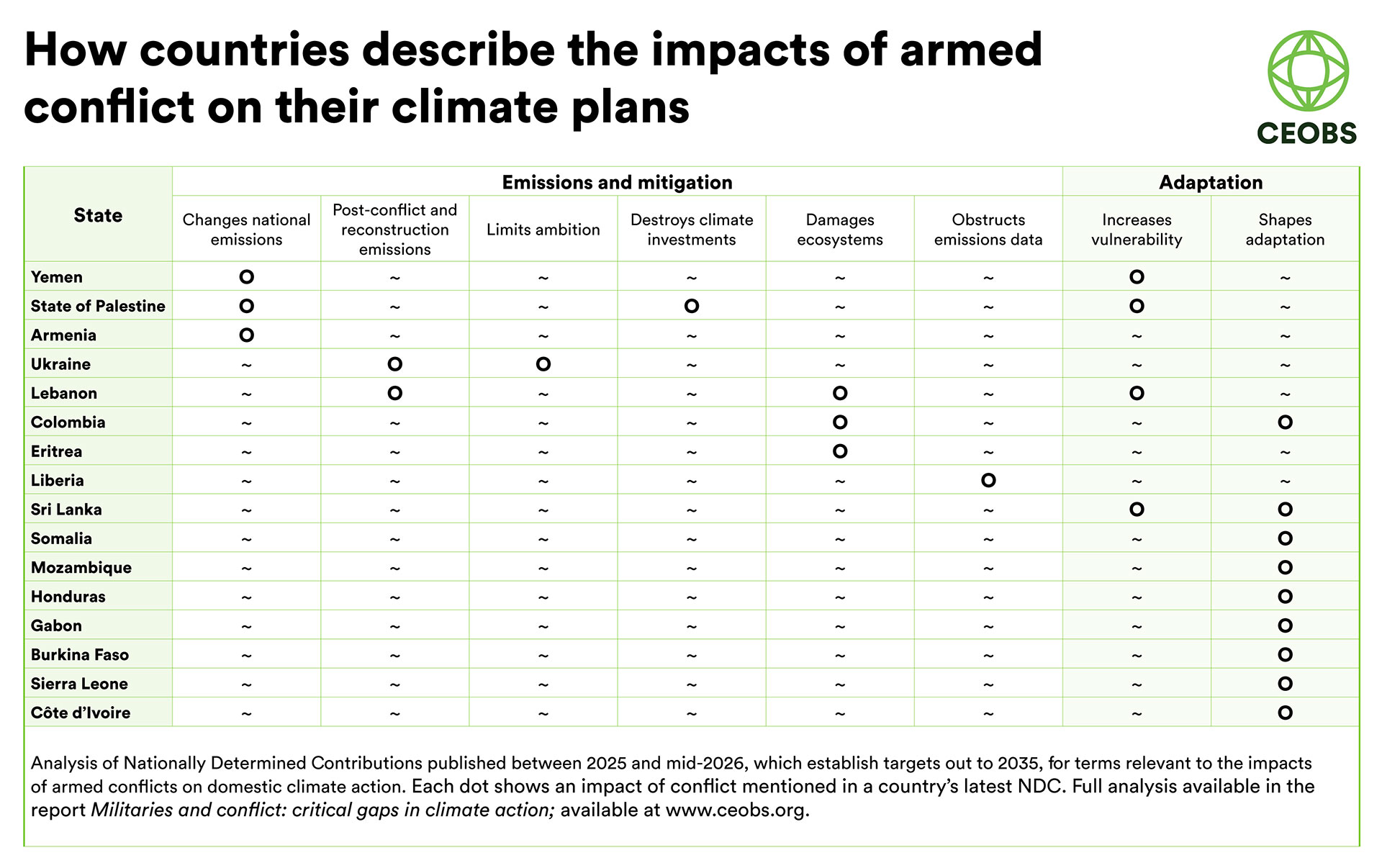
The analysis of NDCs shows that these impacts are increasingly recognised by countries themselves; 16 NDCs mentioned links between conflict and climate change, in relation to either mitigation or adaptation.
2.1 Conflict, emissions and mitigation
Six countries — Lebanon, Ukraine, the State of Palestine, Yemen, Armenia and Somalia — mention the impact of conflict on emissions. Yemen notes the impact of conflict on lowering emissions due to the severe economic and infrastructural disruption on the economy, with emissions falling by around 30% between 2012 and 2024. It notes that the conflict has destroyed power plants, halted oil exports, and constrained industrial output resulting in the conflict-induced collapse of industrial production and energy infrastructure, shaping the country’s emission trajectory. Similarly the State of Palestine notes that its emissions are “suppressed by destruction and by restriction, not by mitigation”. Meanwhile Armenia noted the impact of conflict on emission trajectories via the impact on agricultural emissions and livestock populations.
These falls in emissions are the result of economic collapse and impacts rather than climate action, and the State of Palestine notes that its emissions are expected to rise as recovery and reconstruction take place. Ukraine similarly notes that reconstruction “may temporarily lead to an increase in GHG emissions”, while Lebanon also refers to post conflict emissions. Somalia on the other hand frames conflict prevention as a way of avoiding emissions and unsustainable resource use.
Conflict is also a barrier to mitigation. Ukraine states that “planning for more ambitious emission reduction goals is objectively limited” due to uncertainty over the scale of recovery. The State of Palestine notes that climate assets delivered under its previous NDC have been destroyed, meaning “this cycle begins below where the last one ended”. Conflict can also limit countries’ ability to measure their emissions, with Liberia noting that some categories in its GHG inventory could not be assessed because of the civil conflict.
Conflict has also damaged ecosystems and carbon sinks. Lebanon cites the impact of conflict on its carbon sinks, and Eritrea cites conflict and war among the causes of the severe degradation of its forests. Colombia notes that rivers, forests and high-altitude wetlands “were both the battleground and victims of the war”. In response, Colombia adopts a “peace with nature” approach, framing peacebuilding and climate action as inseparable processes.
2.2 Conflict, vulnerability and adaptation
Conflict also undermines countries’ ability to adapt to climate change. A number of countries note how conflict itself increases vulnerability to climate impacts. The State of Palestine highlights the destruction of water, wastewater, energy and health infrastructure in Gaza, all of which are essential for adapting to climate impacts. Sri Lanka notes that displacement from conflict-affected areas to cities has increased the density of informal settlements, many of which are located in hazard-prone areas such as flood zones. Drawing on the findings of the Global Stocktake, Lebanon has also incorporated the disproportionate vulnerabilities of fragile and conflict-affected states into its adaptation priorities and support needs.
In response, several NDCs include conflict sensitive approaches to adaptation, aiming to ensure that adaptation takes account of conflict risks, including those of Somalia, Honduras and Gabon. Overall, while conflict is increasingly recognised in NDCs it is mainly framed as a barrier to development or as a driver of vulnerability. Few countries recognise conflict as a source of emissions and none address the emissions generated by their militaries.
Table 4: Summary of national NDC references to the impact of conflict and military activity on the climate.
| Country | Annex | NDC year | Summary | Type of Conflict-Climate Link |
|---|---|---|---|---|
| Lebanon | Non-Annex I | 2025 | Explicitly recognises climate harms resulting from armed conflict and military activities, including destruction of carbon sinks and post-conflict emissions. It frames conflict as a source of climate harm and links recovery from war with climate resilience and adaptation. | Conflict impact on emissions; Environmental damage from conflict |
| Ukraine | Annex I | 2025 | Russia’s military aggression has destroyed energy, industrial and transport infrastructure. The resulting reconstruction requires large amounts of materials and may temporarily increase GHG emissions. Continued military action creates uncertainty over further destruction and emissions. The war also limits the ability to plan ambitious emissions reductions, although Ukraine continues decarbonisation efforts. | Conflict impact on emissions; Conflict as a barrier to climate action |
| Armenia | Non-Annex I | 2025 | Conflict is identified as one of several factors influencing fluctuations in agricultural emissions, alongside economic pressures, climate risks, COVID-19 and changes in agricultural practices. | Conflict impact on emissions |
| Yemen | Non-Annex I | 2025 | Conflict caused severe economic and infrastructural disruption, including destruction of power plants, halted oil exports and reduced industrial production. This contributed to a ~30% decline in GHG emissions, largely through economic contraction, fuel shortages and reduced fossil-fuel use. | Conflict impact on emissions; Conflict-climate vulnerability link |
| Somalia | Non-Annex I | 2025 | Focuses mainly on the interaction between climate change and conflict. Climate shocks increase pressure on scarce resources and can exacerbate tensions and insecurity. Frames conflict prevention as a way of avoiding emissions and unsustainable resource use. It also calls for conflict-sensitive climate adaptation and resource management. | Conflict impact on emissions; Climate impacts on insecurity; Conflict-sensitive adaptation |
| State of Palestine | Non-Annex I | 2026 | Notes that emissions “are suppressed by destruction and by restriction, not by mitigation”, and that climate assets delivered under its previous NDC have been destroyed, so “this cycle begins below where the last one ended”. Describes the destruction of water, wastewater, energy and health infrastructure in Gaza and frames the occupation as a threat multiplier for climate risk and adaptive capacity. | Conflict impact on emissions; Conflict as a barrier to climate action; Conflict-climate vulnerability link |
| Colombia | Non-Annex I | 2025 | Frames peacebuilding and climate action as inseparable. Armed conflict damages communities and ecosystems, while peacebuilding is presented as supporting environmental protection, restoration and climate action, through a “peace with nature” approach. | Environmental damage from conflict; Conflict sensitive adaptation |
| Sri Lanka | Non-Annex I | 2025 | Notes that displacement from conflict-affected areas to urban areas has increased the density of informal settlements, many in hazard-prone areas such as flood zones, raising vulnerability to climate impacts. Notes that unequal access to adaptation support could deepen social tensions. | Conflict-climate vulnerability link; Conflict-sensitive adaptation |
| Liberia | Non-Annex I | 2025 | The civil conflict is mentioned as a constraint on GHG inventory data collection: some emissions categories could not be assessed due to the civil conflict. | Conflict as a barrier to data collection |
Countries are referencing conflict as directly impacting their ability to reach their climate targets, and mitigate their emissions, and the impacts of climate change on populations. This is likely to grow with the number of state-based conflicts reaching a record 65 in 2025, and global military spending rising for the eleventh consecutive year. At the same time, multilateral cooperation is weakening, with official development assistance (ODA) falling by 23.1% in 2025. Ultimately, addressing conflict is essential to achieving climate goals. Investing in peacebuilding and conflict resolution, and recognising the impact of conflict within climate planning and reporting, is important in order to both account for the impacts of conflict, and to support affected countries.
Examples of how two states discuss the climate impact of conflicts in their NDCs.
Lebanon
In its NDC, Lebanon explicitly recognises armed conflict and military activities as sources of harm to the climate system, including through the destruction of carbon sinks and post-conflict reconstruction emissions.
“…In line with Articles 15-20 of the 2025 International Court of Justice Advisory Opinion, which reaffirm States’ obligations under international climate treaties and customary law to prevent and mitigate harms to the climate system, particularly from armed conflict and military activities including the destruction of carbon sinks and post-conflict emissions, Lebanon acknowledges the legal imperative to integrate these responsibilities into national climate planning…”
The NDC also calls for climate harms resulting from conflict to be addressed including “the protection and restoration of carbon sinks”.
Ukraine
Ukraine’s NDC describes extensive destruction of energy, industrial and transport infrastructure caused by military action. This has implications for emissions in two directions: continued military action may cause further destruction and emissions, while the subsequent reconstruction process may itself temporarily increase GHG emissions because of the material resources required. The NDC also notes the impact conflicts can have on making effective climate action plans, due to the uncertainty about conflict related destruction and material needs for reconstruction.
“…planning for more ambitious emission reduction goals is objectively limited due to the extremely high level of uncertainty regarding the scale of recovery, the dynamics of economic growth, the future structure of the energy balance and the pace of decarbonization. Military actions have destroyed a significant part of the energy, industrial and transport infrastructure, while reconstruction requires the involvement of large amounts of material resources, which may temporarily lead to an increase in GHG emissions during the reconstruction period… In addition, there is uncertainty about the timing and intensity of military actions on the territory of Ukraine caused by the military aggression of the Russian Federation, which in turn may lead to further destruction of Ukraine’s infrastructure and economy, as well as an increase in GHG emissions…”
2.3 Missing links between conflicts and emissions
While conflict is increasingly noted in countries’ NDCs, it is primarily referenced by non-Annex I countries, many of which are experiencing conflict directly. The emissions from military activity, which is often an important mechanism through which conflict causes this damage, are notably absent. None of the NDCs reviewed set out measures to reduce military emissions, and the NDCs of some of the world’s largest military spenders make no reference to the military at all. This creates a missing link, whereby the climate impacts of conflict are recorded by the countries that experience them, while the military emissions that contribute to them go unreported by the countries that produce them.
Conclusion and recommendations
Overall, military emissions remain largely absent from countries’ mitigation commitments under the UNFCCC. Across the most recent NDCs, the analysis showed that countries have not included explicit mitigation commitments for military sector emissions. This is despite the large share that the military sector contributes to global emissions. This creates an action and accountability gap, with emissions from a highly polluting sector remaining outside of mitigation pathways. Without clear targets and the inclusion of a large, and growing, source of emissions, countries will face a challenge in meeting their climate targets. In order to keep as close as possible to the Paris Agreement’s aim to limit global temperature increase to 1.5°C, militaries must be included in national climate plans, with clear targets for decarbonisation and emissions reductions.
While conflict is recognised as hindering climate action in several NDCs, the impacts of conflict on the climate still remain an under-recognised dimension. More could be done to recognise the role of conflict as a barrier to adaptation and a driver of emissions. The NDCs examined show that conflict can affect emissions and climate action through multiple pathways: by damaging infrastructure and ecosystems, increasing emissions during destruction and reconstruction, disrupting economies and energy systems, and constraining countries’ ability to plan and implement mitigation. Yet recognition remains uneven, and conflict is rarely considered systematically within national climate strategies. Climate planning should therefore account not only for the emissions associated with military activities but also for how conflict can alter emissions trajectories and undermine both mitigation and adaptation efforts.
Recommendations
Governments
1. Integrate military emissions into NDCs. Governments should include military emissions within climate action plans. This should include clear reduction targets, with timelines and milestones outlined.
2. Improve transparency and reporting of military emissions. Governments should improve the availability, consistency and transparency of data on military emissions through enhanced reporting as well as inclusion within UNFCCC National Inventory Reports, enabling progress towards military decarbonisation targets to be assessed.
3. Account for conflict impacts in climate planning. Consideration should be given to how conflict and post-conflict recovery may affect emissions trajectories, mitigation capacity and climate implementation, including the emissions implications of reconstruction.
4. Prioritise investment in conflict prevention and peacebuilding over increasing military spending, to promote peace and reduce the environmental impact of military activities. Where armed conflict does occur, use all applicable legal frameworks to minimise harm to carbon sinks and to reduce conflict emissions.
UNFCCC
1. Strengthen guidance and reporting standards on military emissions. The UNFCCC should strengthen guidance on the reporting of military emissions for greater transparency and consistency across National Inventory Reports.
2. Recognise the impact of conflict on climate action. Climate reporting and guidance should encourage countries to identify where conflict affects emissions, mitigation capacity, climate implementation and post-conflict recovery.
Analysis and report by CEOBS’ climate, conflict and militaries researcher Grace Alexander. If you have found this report or our work on this theme useful, please donate so that we can continue it.
- Dong, W., Ran, Q., Liu, F., Deng, R., Yang, J., Wang, K., Wang, X., Zheng, D., Li, C., Liang, W. and Chou, J., 2025. Rising military spending jeopardizes climate targets. Nature Communications, 16(1), p.4766.; Parkinson, S. The Environmental Impacts of the UK Military Sector. https://www.sgr.org.uk/publications/environmental-impacts-uk-military-sector; Crawford, N. C. Pentagon Fuel Use, Climate Change, and the Costs of War. https://costsofwar.watson.brown.edu/sites/default/files/papers/Crawford-Pentagon-Fuel-Use-Climate-Change.pdf