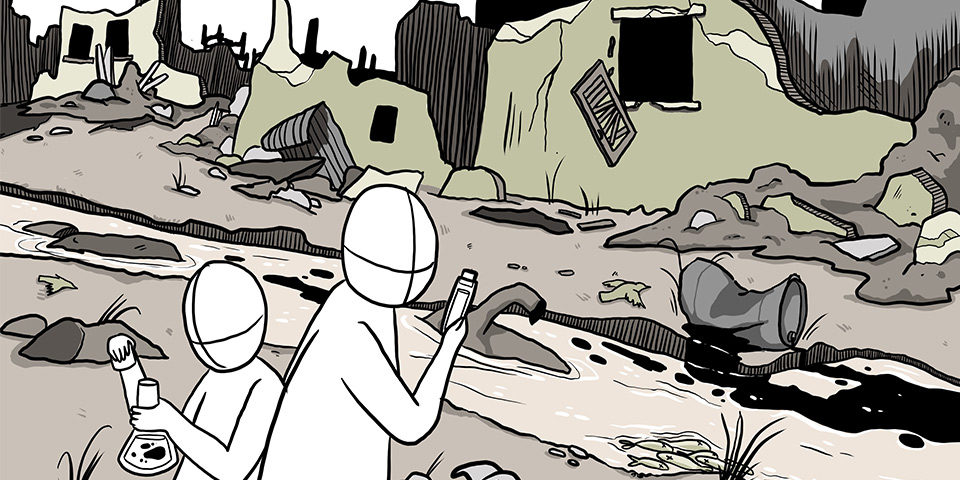
Community-led environmental monitoring offers a vital tool for accountability and resilience in the face of conflict-driven ecological damage.
Elaine Donderer reports on the first in-person event of the European Citizen Science Association’s new working group on citizen science in areas affected by armed conflicts, which took place at the Association’s 2026 conference at the University of Oulu, Finland.
Introduction
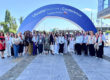
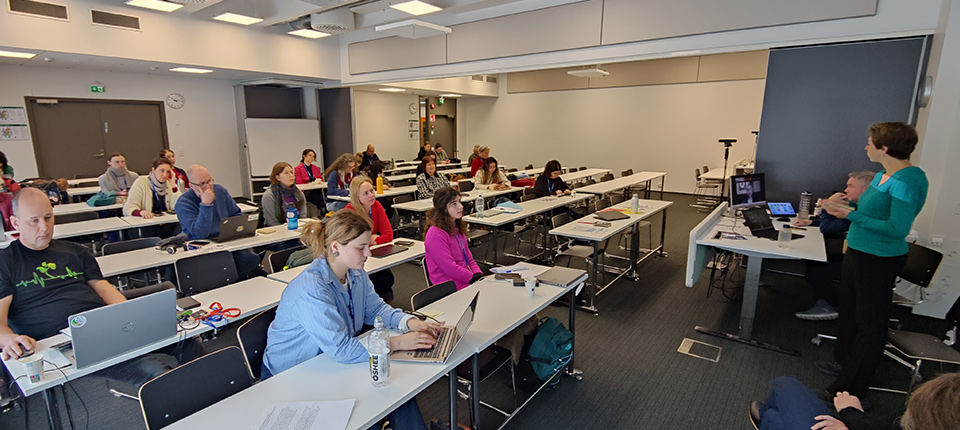
The European Citizen Science Association (ECSA)’s working group on citizen science in areas affected by armed conflicts was established in 2025, and ECSA’s March 2026 conference at the University of Oulu, Finland, was its first opportunity to hold an in-person event for the wider community.
The environmental consequences of war extend far beyond the immediate destruction of landscapes; they can trigger a systemic collapse of environmental management that leaves a legacy of pollution and resource scarcity. While satellite imagery and social media have begun to narrow the information gap, in many areas robust data from the ground remains scarce, contributing to the environment’s underprioritisation in responses.
The working group believes that participatory research can help address this, and the roundtable brought together a diverse group of researchers, practitioners, and activists gathered to discuss the burgeoning role of citizen science in fragile contexts, exploring how local participation can fill data gaps, trigger national assessments, and foster community-led resistance against environmental degradation.
The environmental data gap in conflict zones
During the opening session, Doug Weir from the Conflict and Environment Observatory (CEOBS) highlighted a persistent challenge: environmental monitoring in conflict has tended to be both anthropocentric and retrospective. We traditionally waited for post-war assessments by UN actors which, while valuable, can miss the granular detail required for local recovery and accountability.
The shift toward ‘citizen science’ — or as many participants preferred, ‘participatory sensing’ and ‘civic monitoring’ — is born from necessity. In areas where state monitoring systems have collapsed, communities are often the only actors capable of documenting the ‘truth’ of their changing environment. However, as the roundtable explored, this is not a simple task of handing out sensors; it is a complex negotiation of safety, technology, and trust.
A uniquely diverse working group
The event marked a milestone for the working group. Anna Berti Suman from Italian NGO A Sud, who together with Doug Weir co-chairs the group, noted that since its inception in May 2025, the group has attracted more than 50 members. Its diversity is unusual within ECSA, bringing together experts in radiation monitoring from Ukraine, tree mapping specialists from Sudan, and social scientists focused on the ethics of ‘extreme’ citizen science.
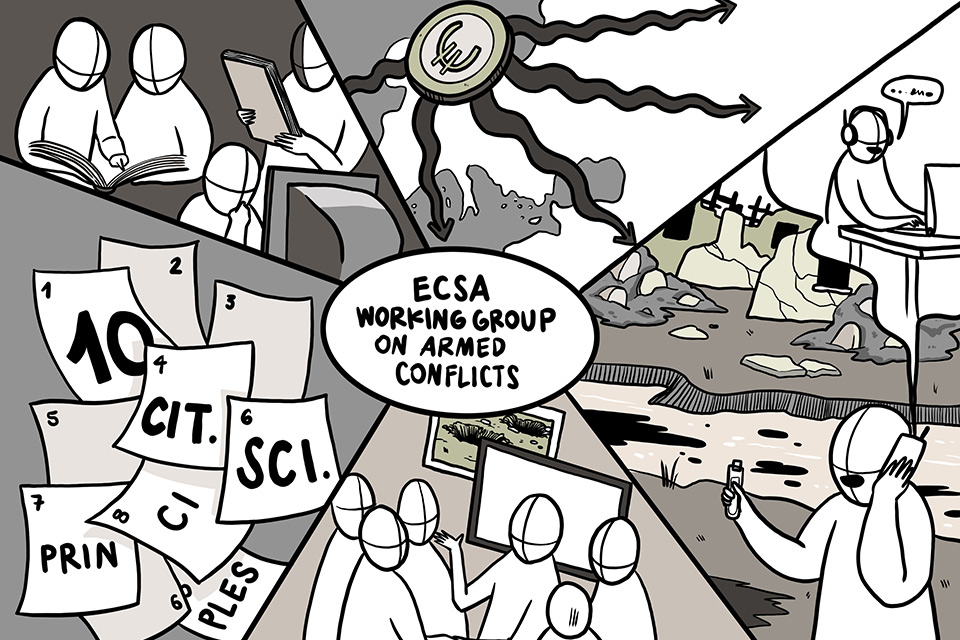
The working group’s achievements to date include a detailed mapping exercise of existing global practices, and a series of webinars exploring projects, many being implemented by its members, that are already gathering data in these contexts. One of its goals is to reimagine ECSA’s 10 Principles of Citizen Science, to ensure that they are applicable in contexts where participation can carry a risk to life.
Resilience through data: stories from the ground
At the heart of the session were discussions where citizen science researchers and practitioners from various conflict zones shared their experiences.
Domiziana Ferrari set the scene by exploring how citizen science can help to address the environmental data gap associated with armed conflicts, and where frameworks that combine community observations, low-cost sensors, and satellite imagery can collect environmental data, even where traditional monitoring has broken down.
Korina Defteraiou, from Web2Learn discussed research on Ukraine undertaken as part of the Gromada Project and which had documented the extent to which digital technologies were supporting participatory research during the ongoing war. The dialogue moved quickly from the potential of technology to the harsh realities of the field.
Harvard University’s Ahmed Siddig shared the challenges of monitoring Khartoum’s urban trees — a vital resource for climate mitigation. They described the ‘security-data paradox’: while the team wanted to use standardised platforms, security professionals warned that sending GPS locations could be misinterpreted as intelligence work by opposing military factions. Consequently, the project pivoted to a ‘low-profile’ WhatsApp networking model, trading standardisation for the safety of its participants.
Mazin Qumsiyeh from the Palestinian Museum of Natural History spoke passionately in support of environmental sovereignty and education under systems of oppression, and of the importance of building participation in communities. Caroline Michellier of the Royal Museum for Central Africa explained how she had used participatory methods for disaster risk reduction in the DRC, throughout periods of varying insecurity. Recently the renewed onset of conflict had led to an 80% drop in data collection due to hardware theft, lost bandwidth, and restricted field access.
Karam Robeil, an Environmental Policy Researcher from Iraq , expanded on the challenges of working in post-conflict settings. His work to develop community led water quality testing in Iraq had to navigate suspicion and reluctance from local authorities, underlining the difficulties in establishing research in contexts with weak governance and influential vested interests.
One poignant question that arose during the session was why look at trees when people are being killed? Ahmed’s response was clear: environmental assets like urban trees are essential post-conflict resources for health, microclimate regulation, and psychological recovery. Citizen science, in this light, is not a luxury; it is a form of community-building and a way to reclaim agency in a situation where people are often treated as passive victims.
Achievements and the road ahead
The working group is currently taking stock of successful examples, such as Save Dnipro’s radiation monitoring efforts in Ukraine, to create a shared taxonomy for the field. One significant discussion point was the shift in language — moving away from the term ‘citizen’, which can be exclusionary for displaced persons or those in occupied territories, toward more inclusive terms like ‘participatory research’ or ‘human-centric sensing’.
Looking forward, the group aims to develop:
- A (potentially open-access) database of conflict-related citizen science projects hosted on the CEOBS website.
- A policy brief and a civil society booklet translated into multiple languages to support local practitioners.
- Contributing to a formal revision of ECSA’s 10 Principles, and exploring protocols relevant to high-risk contexts.
Conclusion: science as diplomacy
The event concluded with a powerful reflection on the role of the scientist in these settings. Karam, a practitioner from Iraq, emphasised that in post-conflict spaces the researcher must act more like a diplomat than a partisan advocate. The goal is to maintain an objective process that provides direct benefits to the community — whether through training, equipment, or a seat at the decision-making table.
As the ECSA working group continues to grow, it serves as a reminder that even in the darkest periods of human conflict, the pursuit of scientific truth can be a powerful tool for community empowerment, peacebuilding and environmental justice.
Elaine Donderer is Specialist in Ecosystem-based Disaster Risk Reduction, working with the Arava Institute of Environmental Studies, as well as the German Environment Agency. To learn more about the working group or to contribute to the ongoing mapping of projects, visit the ECSA website or contact CEOBS.