
Studying how humans and wildlife interact with minefields is key to identifying policies that minimise the impact of clearance on nature.
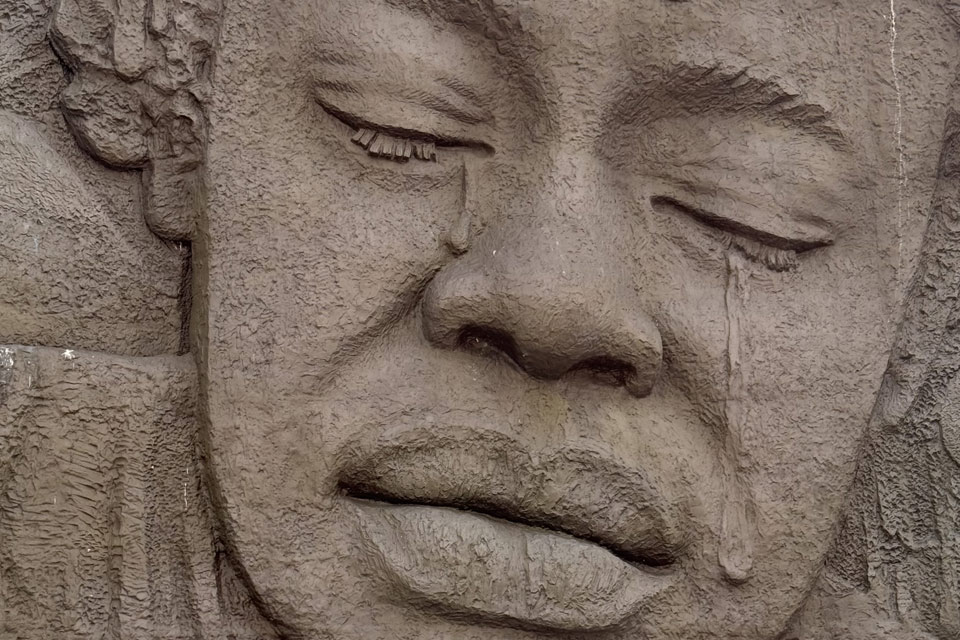
By excluding people minefields can reduce pressure from human activities like hunting or development. With governments obliged to clear mines and explosive remnants of war, understanding how their presence and removal influences biodiversity is critical. In this post, Dr Franciany Braga-Pereira describes what she and her team discovered studying minefield refugia in Angola.
Introduction
In southern Angola, entering a mined landscape is never just a matter of arriving at a field site. Routes are discussed in advance, movements are coordinated with demining teams, and every conversation with residents carry memories of places that are still feared, avoided, or entered only out of necessity.
Southern Angola’s conservation challenges are inseparable from the country’s long civil war, which began after independence in 1975 and continued until 2002. The war pitted the Movimento Popular de Libertação de Angola (MPLA; Popular Movement for the Liberation of Angola) government and its armed forces, the Forças Armadas Populares de Libertação de Angola (FAPLA; People’s Armed Forces for the Liberation of Angola), against the União Nacional para a Independência Total de Angola (UNITA; National Union for the Total Independence of Angola), the movement led by Jonas Savimbi, and became deeply entangled with Cold War military support.
In Cuando Cubango province, in Angola’s remote south-east, the battle of Cuito Cuanavale in 1987–88 was one of the largest battles of the Angolan civil war. Following a FAPLA offensive towards the town of Mavinga, forces of the FAPLA backed by Cuban and Soviet troops, confronted UNITA and South African forces. The conflict resulted in extensive deployment of anti-personnel and anti-vehicle mines by all sides, leaving vast areas inaccessible and dangerous for decades after the war. The municipality of Cuito Cuanavale is still widely described as Africa’s most heavily mined town. Further south-east, Jonas Savimbi established UNITA’s headquarters in the town of Jamba, in an area that today lies within the centre of the Luengue-Luiana National Park (LLNP).
During the war, wildlife became part of the conflict economy. In Luiana Partial Reserve, now part of the wider LLNP, UNITA used elephant ivory and rhino horn to pay for arms and meat to feed its soldiers. The toll on Angola’s elephants drew international alarm in the 1980s, with reports of up to 100,000 elephants killed in rebel-controlled territories. However, the full impact remains uncertain because there were no reliable population estimates. Today, Luengue-Luiana and Mavinga form Angola’s largest contiguous protected area landscape and one of the largest national park complexes in Africa, covering almost 90,000 km². They also occupy a strategic position within the Angolan component of the Kavango-Zambezi Transfrontier Conservation Area, encompassing critical ecosystems across the borders Angola, Botswana, Namibia, Zambia, and Zimbabwe — and linking Angola to wider elephant movement routes and regional conservation planning.
Yet this conservation frontier remains deeply shaped by the war: since 2020, demining teams have worked across 125 minefields in Luengue-Luiana and Mavinga, clearing more than 9.5 million m² of land. This makes the region simultaneously a post-war mine-action landscape and a critical conservation frontier, where biodiversity recovery depends not only on protection, but also on how demining reshapes human access, land use and wildlife movement.
Drones, interviews and safe fieldwork
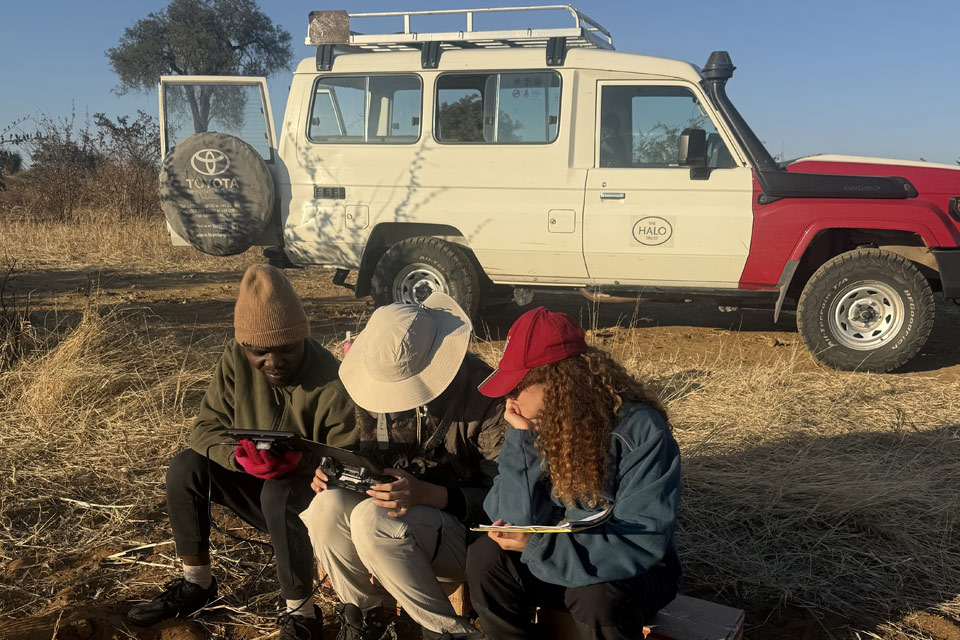
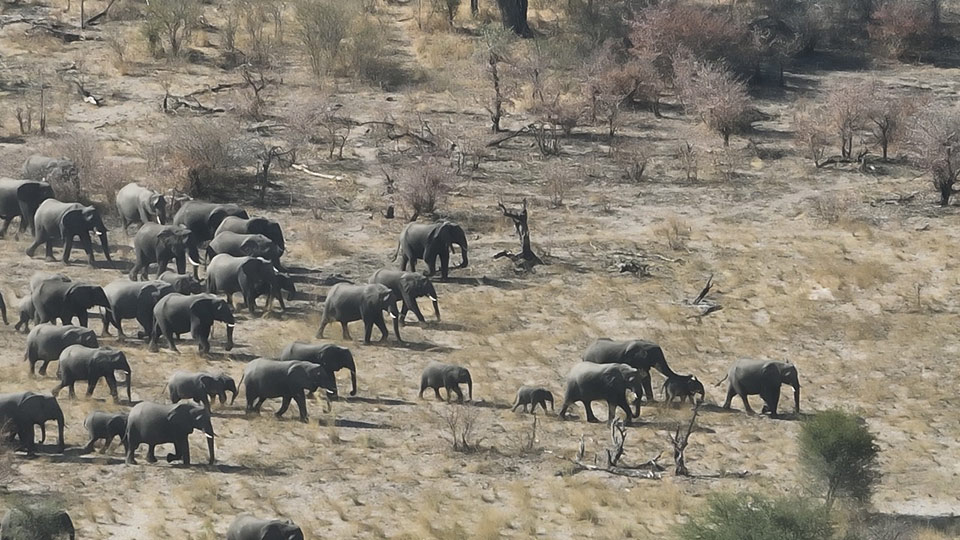
Studying biodiversity in mine-affected landscapes means confronting more than just an ecological question. It also requires navigating the lived memory of war, the practical limits of access, and the risks posed by explosive remnants still present in the ground. To understand the legacy of landmines for biodiversity, we therefore combined semi-structured interviews with drone-based wildlife monitoring in mined and non-mined areas. For the interviews, we spoke with residents in eight different dialects and local variants, with the support of exceptional translators. They helped build trust, explain the study’s aims, and enable respectful dialogue with communities carrying deep memories of war, hunting, and changes in wildlife over time. In parallel, drones allowed us to observe extensive areas without requiring the team to move unnecessarily through potentially dangerous terrain.
At the end of the field campaign in each community, we organised small “community cinemas”, projecting videos of animals recorded by drones onto the walls of local meeting places during the fieldwork. These moments became one of the most moving parts of the work, bringing together elders, young people and children to watch aerial images of the animals living in their own region. During one of these sessions, one local leader said, visibly moved: “If my parents were alive, they would not believe that one day we would have a cinema in our community.” His words captured something that went beyond the research itself.
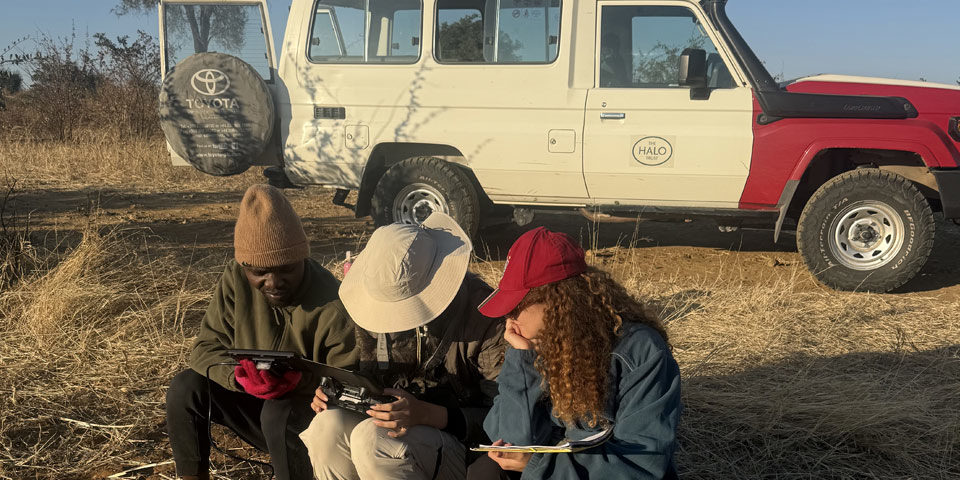
The fieldwork, however, was only possible thanks to our partnership with The HALO Trust, which ensured the team’s safety in remote areas marked by decades of landmine contamination. HALO provided trained drivers capable of navigating these landscapes, as well as support from the operations lead during the expedition, whose experience in military and demining operations across different countries was fundamental in guiding every movement. On our very first day in the field, we gained a concrete sense of what it meant to work in a mined landscape. After long hours of travel, the car stopped so that we could step out and stretch our legs. It was then that the operations lead gave us our first safety instruction: we could walk no more than about 15 metres from the road, because only that strip was considered safe after demining. This guidance made it clear that, in that landscape, every step had to be carefully considered, and that the biodiversity we were trying to understand coexisted with a legacy of war still materially present in the soil.
Minefields as wildlife refuges? A more complicated story
There is a widespread idea that landmines, by limiting human access to certain areas, can create accidental refuges for wildlife. However, our study in southern Angola suggests that the relationship between landmines and fauna is far more complex than the simple notion of “minefields as natural refuges”. What we instead found through our monitoring and interviews is that this effect depends on the species’ body size and behaviour, and on people’s willingness to take risks to access the area. In some accounts, smaller or lighter animals, such as monkeys, small antelopes and other species that move cautiously through the landscape, appear to persist better in contaminated areas, especially where mines are buried more deeply or where the animal’s weight is insufficient to trigger them. In these situations, reduced human presence in mined areas may create indeed refuges for those species. However, for large animals, particularly those that use trails, riverbanks, bridges and movement corridors where landmines were often placed, the situation appears quite different. Elephant, buffalo, and large antelopes may trigger mines, die, or become injured. Interviewees also perceived that when an animal triggers a mine, other individuals may avoid that place for some time afterwards, apparently responding to the explosion, the smell and noise it produces, and the sight of another animal suffering or dying. More sensitive species were frequently associated with displacement, local disappearance, or failure to return even after clearance had taken place.
At the same time, the danger posed by mines does not completely prevent human access. Some people enter contaminated areas without knowing; others enter despite being aware of the risk. The need to collect honey, mushrooms, timber or bushmeat, or to recover domestic animals, leads residents to cross dangerous areas. More experienced hunters, including former soldiers, were also described as being able to venture into mined zones, opening paths with tools or following animal tracks. In some communities, animal bones, craters, or ground markings serve as informal signs of danger, revealing how people have learned to read the landscape through the experience of war.
Protecting wildlife from mine clearance
To prevent demining from creating a new frontier of pressure on biodiversity, at least six measures should be integrated. First, clearance priorities should incorporate ecological risks and conservation opportunities alongside humanitarian and economic criteria. This requires assessing whether demining will help restore ecological connectivity or instead expose intact ecosystems to logging, hunting, mining, settlement, or agricultural expansion.
Second, land release should be integrated into protected area management and territorial zoning plans. Before reopening areas, governments and local stakeholders should map sensitive habitats, wildlife corridors, high-conservation-value forests, and community land uses to ensure that access and development are appropriately regulated.
Third, demining operations should minimise direct environmental damage. Heavy machinery, vegetation removal, detonations, and road construction can degrade fragile ecosystems, cause erosion, and disrupt hydrology. Operational guidelines should therefore limit unnecessary disturbance and include site rehabilitation measures where needed.
Fourth, post-clearance monitoring should track both ecological recovery and emerging human pressures. Indicators such as wildlife presence, vegetation change, new trails, hunting activity, and shifts in human movement can provide early warning of unsustainable exploitation or habitat degradation following reopening.
Fifth, enforcement capacity and institutional presence should be strengthened immediately after clearance. Newly accessible areas are often vulnerable to opportunistic settlement, illegal extraction, and wildlife exploitation, particularly where governance remains weak. Rapid deployment of rangers, local authorities, and community governance systems is therefore essential.
Finally, conservation-compatible livelihood opportunities should accompany clearance efforts. Without sustainable economic alternatives, reopened landscapes may quickly become dependent on destructive activities such as illegal hunting or logging. Community-based ecotourism, restoration employment, ranger programmes, agroforestry, and other nature-based livelihoods can help align recovery with long-term conservation objectives.
Conclusion
In southern Angola, landmines continue to shape landscapes long after the end of conflict, influencing not only human security but also ecological processes and patterns of wildlife persistence. Rather than functioning simply as accidental refuges, mined areas create complex and uneven effects across species, habitats, and human communities. Some areas may experience reduced exploitation, while others become fragmented, inaccessible, or ecologically degraded.
The challenge moving forward is therefore not only to remove mines and explosive remnants of war, but to manage the transition that follows their removal. Clearance represents a critical turning point in which previously isolated landscapes may rapidly become exposed to new pressures, including settlement, infrastructure expansion, logging, hunting, and agricultural conversion. Whether these landscapes experience ecological recovery or renewed degradation will largely depend on the governance, planning, and conservation measures accompanying their reopening.
Franciany Braga-Pereira is a Marie Skłodowska-Curie Research Fellow at Manchester Metropolitan University, leading research on the impacts of war on biodiversity. More information is available at: https://franbraga.com. This research was made possible by INBAC, The HALO Trust, and the Federal University of Viçosa, and the local people and field assistants who shared their knowledge and supported this fieldwork.