There are a number of countries in the world that can show us how to do effective DRR in areas with high levels of armed violence.
Countries enduring conflict are hit harder and suffer more deaths when disasters such as storms and earthquakes strike. Rebekah Harries asks whether disaster risk reduction frameworks doing enough to acknowledge this link between conflict and disaster risk?
Introduction
In May 2008, Cyclone Nargis struck Myanmar while it was under the control of a military junta, resulting in nearly 140,000 deaths and 2.4 million affected people. Instead of providing disaster relief, the military used its organisational capacity to shepherd people into polling stations and restricted access to impacted areas out of fear that foreign aid would destabilise their political oppression.
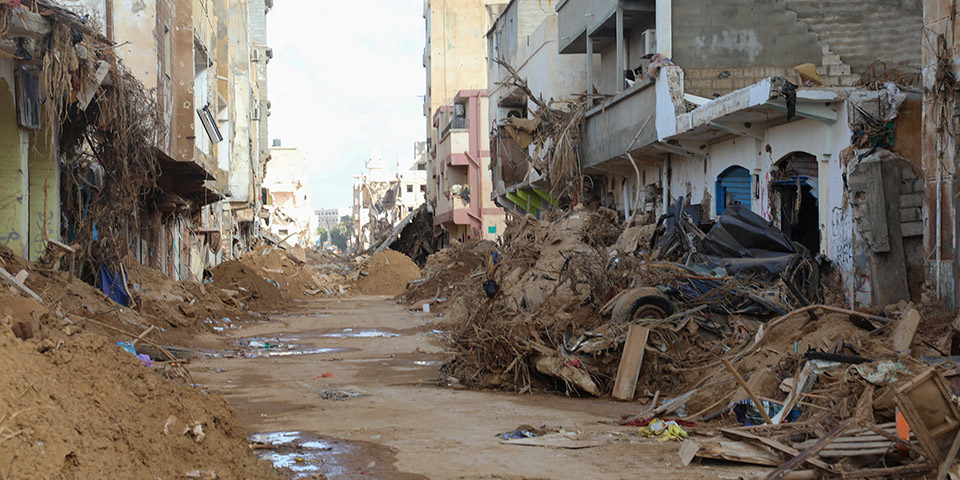
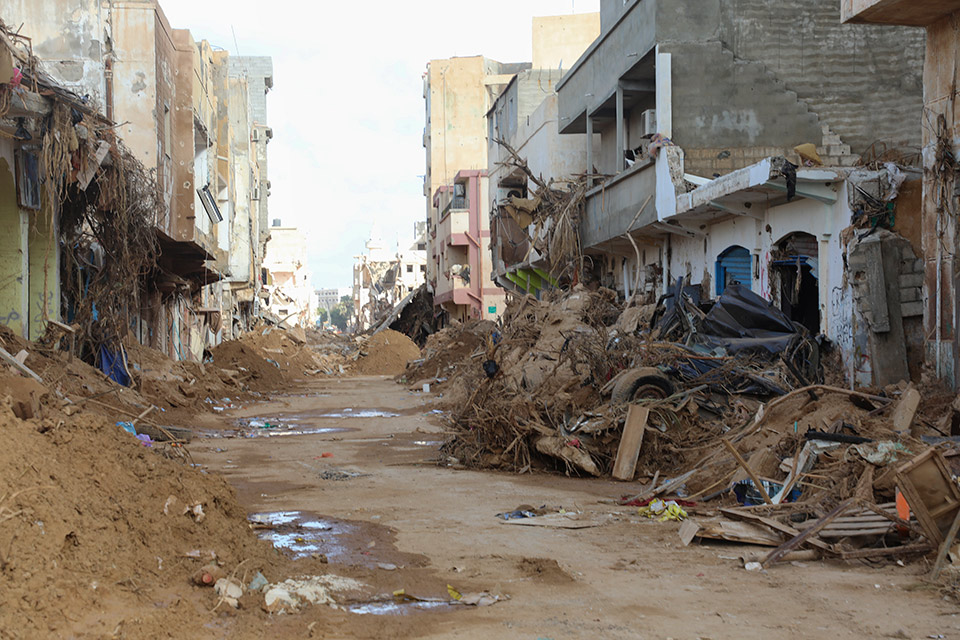
In eastern Libya, 4,200 people were killed and entire neighbourhoods destroyed as two critical dams that had fallen into disrepair during prolonged insecurity failed to withstand Storm Daniel. In 2023, an earthquake impacted Türkiye and Syria, demanding a major humanitarian response. But in Syria, a decade of civil war had created complex legal and geopolitical barriers that severely delayed cross-border humanitarian access to opposition-held areas.
These are not isolated examples. Conflict-affected countries face more frequent disasters and suffer more deaths from them. This is because broken institutions, destroyed infrastructure, forced displacement, and disrupted aid, amplify the impact of hazards, turning floods, earthquakes, and storms into avoidable human catastrophes.
It is remarkable, therefore, that armed conflict and contested governance fail to be acknowledged or even mentioned in the current global policy framework guiding collective action on reducing the frequency and severity of disasters.
The silence of Sendai
The Sendai Framework for Disaster Risk Reduction (DRR) is a global agreement adopted in 2015 that guides action on reducing the risk of disasters, and the losses they cause. It provides a roadmap for countries to move towards prevention, preparedness, and resilience rather than just humanitarian disaster response. It has four priority areas that align with the Sustainable Development Goals: to increase understanding of disaster risk, strengthen governance, invest in resilience, and improve preparedness and recovery. Countries are encouraged to submit self-assessment reports of their progress in seven key areas that include developing national disaster risk strategies, strengthening international cooperation, and improving access to early warning systems by 2030. To date, progress towards these goals has been unequal across countries, and explanations for these discrepancies have often neglected the role of armed conflict.
The Sendai Framework has deliberately insulated itself from peacebuilding and statebuilding agendas in an effort to secure universal political agreement. During initial negotiations, the terms ‘armed conflict’ and ‘foreign occupation’ were purposefully excluded because some governments viewed them as politically sensitive. As a result, action plans for reducing disaster risk in Myanmar, Libya or Syria make no reference to the political environment being a major barrier to progress. As the incidence of violent conflict is increasing — it has doubled between non-state armed groups, for instance, since 2010 — there is every likelihood that this apolitical stance is entrenching inequality and vulnerability in the world’s most fragile regions.
In 2021, the UN formally recognised armed conflict as a hazard, and in 2023 a midterm review of the Sendai Framework acknowledged conflict and geopolitical tension as part of the broader risk landscape impacting its progress. However, briefings outlining the major operational gaps and challenges in conflict and post-conflict settings repeatedly highlight the significant need for more rigorous research on the design, implementation and outcomes of DRR initiatives in conflict and fragile contexts. At present, there are no disaster risk reduction strategies that fully consider how conflict affects vulnerability and hazard exposure, or use that understanding to guide the design and implementation of effective strategies.
After 2030, the Sendai Framework will either be superseded by a new global disaster risk reduction framework or will become embedded into other international frameworks; for example on development or climate action. With political will, there is an opportunity to develop a new peacebuilding-DRR agenda.
A question of national capacity?
There is a general perception that investment in DRR programmes is not feasible in fragile or conflict-affected areas because state-led action requires functioning institutions and technical capacity. While many conflict-affected states have not submitted progress reports under the Sendai Framework, those that have, report widely varying capacity for multihazard early warning (Target G) and national strategy (Target E).
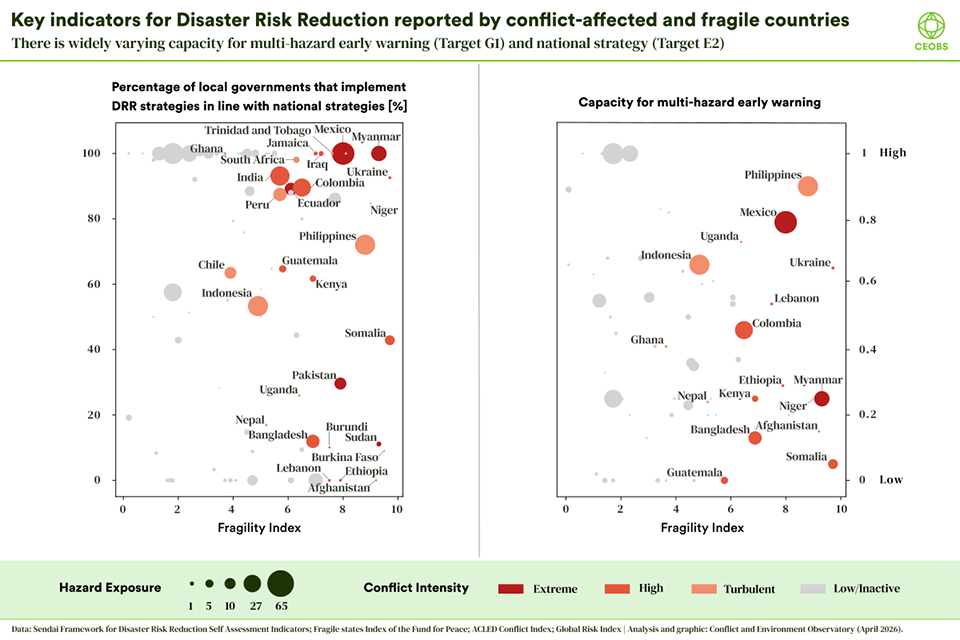
The Philippines, which has ranked the world’s most disaster-prone country since 2011, claims a high capacity for multihazard early warning in spite of violent conflict between non-state armed groups, and the state in its southern archipelago. A similar story in Mexico, which claims all local governments have DRR strategies aligned with national strategy, despite violent disputes between criminal groups fighting for control over illicit economies.
Formal DRR has been carried out in these settings because contemporary civil war is rarely defined by total institutional collapse. Many involve fragmented territorial control and negotiated wartime governance. In these contexts, states and international organisations sometimes engage armed actors in formal DRR initiatives in order to achieve technical success. Done without conflict-sensitivity, these initiatives risk reinforcing existing power imbalances and patronage networks. Unless explicitly conflict-sensitive, DRR initiatives intended to reduce risk can consolidate territorial control and entrench long-term social and political vulnerability.
A question of financial resources?
The mitigation of disasters needn’t be dependent on capital-intensive DRR infrastructure. In countries like Somalia, which report low progress and have received little in the way of foreign investment for disaster prevention or climate adaptation, efforts to reduce risk are occurring on a local scale. Communities adapt agricultural practices. Households diversify livelihoods. Infrastructure is modified. Informal safety nets are strengthened, recognising that early warnings travel through trusted networks rather than formal systems, and that evacuations depend on negotiated cooperation across lines of control. These efforts are rarely labelled “DRR” and are often invisible to global frameworks. But they demonstrate agency, contextual knowledge, and political navigation under constraint.
Even though global DRR policies often highlight the importance of participatory approaches involving communities, there has been a tendency to overlook the value of local knowledge, skills, and lived experience. Instead, local people are often seen mainly as recipients of aid, or sometimes even as part of the problem. These narratives can hide the important work communities are already doing to reduce risks, often with very limited resources. It may also weaken opportunities to develop DRR strategies that are genuinely led by local people and tailored to their specific contexts.
Leaving no one behind
To genuinely “leave no one behind,” DRR must move beyond technical hazard management and it must engage with power, legitimacy, and governance in contested spaces.
There is an urgent need for an evidence-base on which to develop a new integrated DRR-peacebuilding agenda that can take conflict settings as a new starting point. This means, recognising and documenting informal and locally-led DRR efforts, integrating DRR with humanitarian and peacebuilding programming, and embedding conflict sensitivity in infrastructure investment and targeting decisions. Otherwise, well-intentioned interventions risk deepening the very inequalities and political tensions that drive vulnerability in the first place.
Dr Rebekah Harries is a researcher with CEOBS. If you have found this blog insightful please donate so that we can publish more.