It’s time to turn commitments into meaningful action.
The third review conference of the Convention on Cluster Munitions saw governments agree on a new five year action plan that includes deeper integration of climate and environmental considerations. In this post Jonathan Walsh and Anna McKean explore what was achieved and what’s needed now.
Introduction
Mine action activities are often conducted in countries especially vulnerable to climatic and other environmental risks. Mainstreaming climate and environmental considerations into mine action activities therefore not only reduces the exposure of programmes to these risks but it also offers the opportunity to help leave communities and their lands more resilient after clearance work.
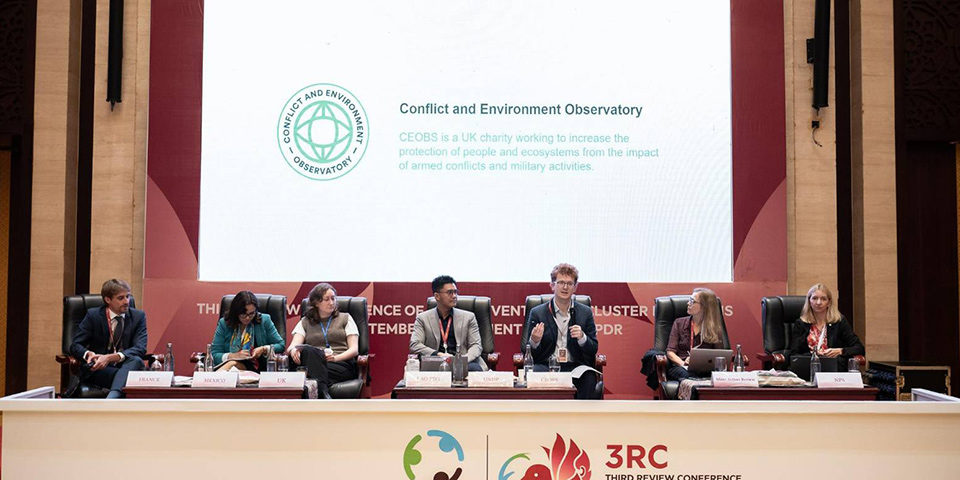
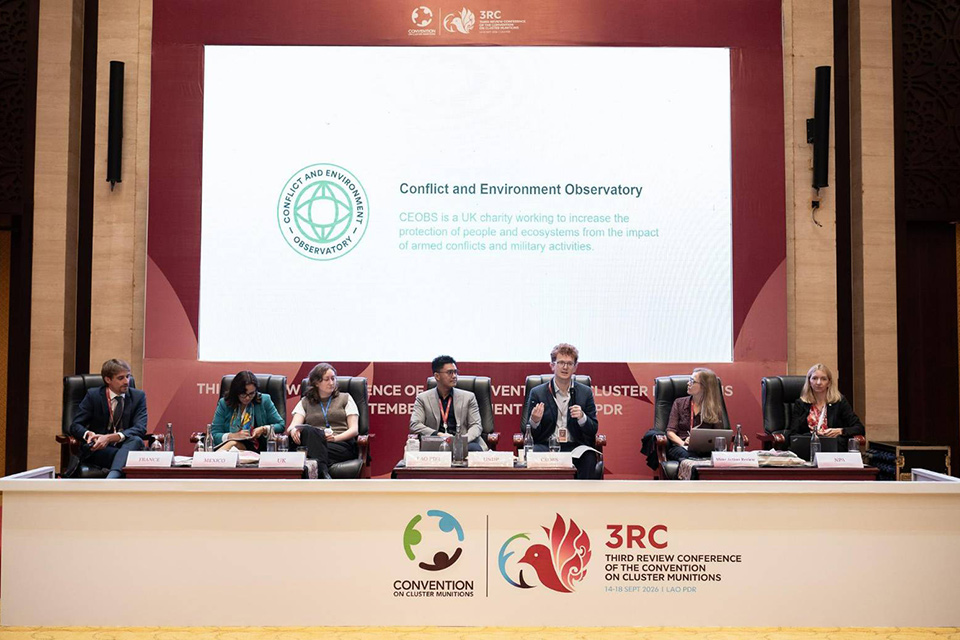
A side event during the review conference of the Convention on Cluster Munitions (CCM) that was hosted by CEOBS and our partners Norwegian People’s Aid (NPA) and Mine Action Review explored these themes in more detail, and their relevance to cluster munition clearance. Interventions from Laos PDR , UK FCDO and UNDP Chad drew attention to current and emerging needs, with further perspectives from Mexico and France; both governments had championed the theme during the conference’s preparatory process.
The mine action sector’s environmental mainstreaming journey is nearly a decade old and is growing ever more salient as the climate crisis and biodiversity loss accelerate. The period has seen the development of a range of new and revised standards, as well as new tools to help support different aspects of mine action work. In this regard, September’s review conference should be seen as the latest milestone in the sector’s journey.
A new action plan
The conference, which heard both progress towards clearance as well as allegations of the fresh use of the weapons, culminated with the agreement of the five-year Vientiane Capital Action Plan for the period 2027-32. The plan includes several new and strengthened environmental and climate actions compared to its predecessor, which was agreed in Lausanne in 2021. As the table below shows, examples of this include survey and clearance, risk education and mainstreaming the environment and climate as cross-cutting issues. Together these represent considerable progress towards mainstreaming and should be celebrated.
Table: Comparing action plan climate and environmental obligations between the Mine Ban Treaty and the Convention on Cluster Munitions.
| Thematic area | Mine Ban Treaty (MBT) 2024 versus 2019 action plan | Convention on Cluster Munitions (CCM) 2026 versus 2021 action plan | Comparison between current MBT and CCM climate and environment obligations | |||
|---|---|---|---|---|---|---|
| National policies and strategies | ★ | CCM doesn't explicitly refer to climate and environmental policy integration. | ★ | New | ||
| Cross-cutting mainstreaming | ★ | ▲ | CCM specifies additional risk-assessment requirements. | ▲ | Strengthened | |
| International frameworks and synergies | ★ | — | MBT links national planning; CCM emphasises synergies. | — | No change | |
| Stockpile destruction | ★ | — | Both address environmental safeguards in destruction. | n/a | ||
| Survey and clearance planning | ★ | ▲ | MBT explicitly addresses national workplans; CCM cross-cutting action applies. | |||
| Survey and clearance methods | ▲ | CCM explicitly references standards, SOPs and quality management. | ||||
| Clearance prioritisation | ★ | ★ | Both include environment and climate in prioritisation. | |||
| Extension requests | ★ | MBT explicitly mentions climate and environment; CCM Action 21 does not. | ||||
| Risk education integration | ★ | ▲ | Both connect risk education with climate/environmental considerations. | |||
| Climate-sensitive risk education | ★ | — | Both address climate/environmental risk in risk education. | |||
| Victim assistance | ★ | MBT explicitly mentions climate and environment; no directly equivalent CCM action. | ||||
| International assistance and knowledge-sharing | ★ | ★ | MBT includes a donor reporting indicator; CCM highlights knowledge sharing. |
The adoption of the new Vientiane Capital Action Plan, and its strengthened environmental actions, follows the inclusion of similar objectives in the Anti-Personnel Mine Ban Convention’s (APMBC) 2024 Siem Reap Action Plan. Yet as the table above shows, in several key areas the CCM’s action plan includes even greater commitments.
This progress is part of a wider pattern of evolving standards, guidance, tools and awareness around the environment and mine action. This has included 2024’s IMAS 7.13 standard on Environmental Management and Climate Change, and 2025’s Technical Note 07.13/01, with its further guidance on how national-level standards should integrate environment and climate risks. Several affected countries have now updated their National Mine Action Standards to reflect this change, while mine action operators are working to integrate environmental monitoring systems. This process has been encouraged by the emergence of the IMAS-compliant Green Field Tool, which was designed and released as an open-source tool by Norwegian People’s Aid (NPA) and CEOBS in 2025.
Moving forward
Encouraging though these new commitments and actions are, work will be needed to adapt mine action activities to meet them. Turning advocacy into action will demand examination of different organisational approaches, environmental and climate contexts, and of the different cultural attitudes that shape how change is implemented. Monitoring and evaluation, alongside sharing knowledge and skills will be particularly vital as budgets for environmental activities are squeezed due to wider development aid cuts.
The new Vientiane Capital Action Plan marks another important step forward but the challenge is now to turn these commitments into meaningful action by the state parties, and thus into tangible benefits both for communities and the environment they depend on.
Jonathan Walsh is a Researcher with CEOBS while Dr Anna McKean is CEOBS’ Senior Advisor on Mine Action and Environment. If you’ve found this post useful, please consider donating so that we can publish more of them.