We can now see how conflicts are impeding the implementation of plans to halt and reverse global biodiversity loss.

As COP17 of the Convention on Biological Diversity begins in the Armenian capital Yerevan, Doug Weir considers the rising profile of nature, peace and security, and its relevance to the successful implementation of the Kunming-Montreal Global Biodiversity Framework.
Introduction
The 2022 Kunming-Montreal Global Biodiversity Framework (KMGBF) is the Convention on Biological Diversity’s (CBD) current plan to halt and reverse the collapse of global biodiversity by 2030. The CBD’s COP17 meeting, hosted and presided over by Armenia, is the first chance for the international community to take stock of progress towards its implementation.
COP17 comes at a time of increasing geopolitical instability that is severely challenging the consensual multilateralism upon which coordinated environmental action depends, whether on nature, climate, land degradation or pollution. Tensions were already present in the CBD and its KMGBF, particularly between the wealthy Global North and biodiversity rich Global South. The framework is not just about protecting nature, it’s also about the equitable and sustainable use of its riches, which include its gene sequences. Similarly, the question of how we pay to protect nature, and who bears which costs are ever present.
Parties to the CBD are tasked with submitting national action plans known as NBSAPs, but have been slow to do so. Ahead of COP17 they were also tasked with reporting on the state of implementation towards the KMGBF’s 25 2030 targets, and its four 2050 goals. Their reports have been summarised into a review, the State of Biodiversity Action, which will be one focus of discussion in Yerevan, among many others.
COP17 is coinciding with increasing attention on the complex relationships between nature, peace and security. These relationships, which run a spectrum from the impact of war on nature, and on its protection, through to the extent to which the collapse of critical ecosystems can threaten national security, are engaging governments, conservationists and peace and security sector actors alike. They are also the focus of CEOBS’ engagement at COP17. To date these topics have remained peripheral to the work of the CBD, and yet the prevailing geopolitical context and the review of implementation should encourage us to question this.
The State of Biodiversity Action in areas affected by conflict or fragility
Armed conflict is recognised by the Intergovernmental Panel on Biodiversity and Ecosystem Services (IPBES) as an indirect driver of biodiversity loss. And it is anticipated that the science-policy panel’s next global report will further examine this connection. The contribution that conflicts or fragility make to biodiversity loss extends far beyond direct wartime damage; it also relates to the impact of conflicts on governance and on national capacity to protect and restore nature. The CBD’s new State of Biodiversity Action report reinforces what research and anecdote had already told us, but breaks this down across the KMGBF’s targets and goals, as highlighted in the table below.
| KMGBF Target or Goal | Excerpts from the State of Biodiversity Action (2026) |
|---|---|
| Target 1. Ensure that all areas are under participatory, integrated and biodiversity inclusive spatial planning and/or effective management processes addressing land- and sea-use change, to bring the loss of areas of high biodiversity importance, including ecosystems of high ecological integrity, close to zero by 2030, while respecting the rights of indigenous peoples and local communities. | Challenges relating to capacity, human resources or institutional constraints are identified by nearly three quarters of Parties reporting on Target 1. Legal, policy and governance challenges are described by about 60 per cent of Parties and include issues such as overlapping mandates between ministries and a persistent disconnect between environmental legislation and sectoral planning instruments in agriculture, infrastructure, mining and energy, among other sectors. A number of Parties, especially those affected by conflict, political instability or rapid economic transition, face additional challenges in enforcing existing laws, such as weak penalties and limited enforcement capacity, allowing harmful practices to persist even in areas under formal protection. |
| Target 2. Ensure that by 2030 at least 30 per cent of areas of degraded terrestrial, inland water, and marine and coastal ecosystems are under effective restoration, in order to enhance biodiversity and ecosystem functions and services, ecological integrity and connectivity. | Many Parties report that the funding that is available for ecosystem restoration represents a fraction of the resources required to meet national targets. Responsibility for restoration is often fragmented across agencies, ministries and sectors. This can lead to contradictory policies and conflicting land-use and sea-use decisions, as well as unharmonized data collection, which can hinder consistent reporting. Restoration gains may be undermined by drivers and underlying causes that continue to degrade ecosystems. Parties include the effects of poverty and conflicts among these underlying causes. |
| Target 21 Ensure that the best available data, information and knowledge, are accessible to decision makers, practitioners and the public to guide effective and equitable governance, integrated and participatory management of biodiversity, and to strengthen communication, awareness raising, education, monitoring, research and knowledge management and, also in this context, traditional knowledge, innovations, practices and technologies of indigenous peoples and local communities should only be accessed with their free, prior and informed consent, in accordance with national legislation. | Data fragmentation, also referred to as the persistence of “data silos”, is a widely cited challenge in relation to Target 21 implementation. Limited human and technical capacity for data management, artificial intelligence applications and indicator development is also reported widely as a barrier. Several Parties report that public awareness of biodiversity loss does not match scientific assessments, and a small number report that conflict or crisis has severely disrupted data collection and knowledge management. |
| Goal D. Adequate means of implementation, including financial resources, capacity-building, technical and scientific cooperation, and access to and transfer of technology to fully implement the Kunming-Montreal Global Biodiversity Framework are secured and equitably accessible to all Parties, especially developing country Parties, in particular the least developed countries and small island developing States, as well as countries with economies in transition, progressively closing the biodiversity finance gap of $700 billion per year, and aligning financial flows with the Kunming-Montreal Global Biodiversity Framework and the 2050 Vision for biodiversity. | Capacity needs are reported across nearly every reporting Party. The absence of in-house biodiversity expertise across ministries covering relevant sectors is reported as a constraint on the mainstreaming of biodiversity issues at a national level. In Parties affected by conflict or institutional fragility, the loss of trained staff is reported as compounding the structural constraints on implementation, with decades of conflict in some cases producing a data vacuum and the loss of institutional memory and trained personnel. Many Parties report that, while monitoring systems may exist, they are underresourced, lack functionality and are geographically incomplete. Technology needs identified by Parties include GIS, remote sensing, analysis assisted by artificial intelligence and integrated digital platforms. In Parties affected by conflict or institutional fragility, monitoring is further constrained by the physical inaccessibility of biodiversity areas, the loss of trained technical staff and the fragmentation of administrative records. |
While these excerpts are just fragments of a much more detailed picture of the barriers to KMGBF implementation, unlike many of the other barriers cited by parties, these currently have no institutional home within the CBD’s architecture. The KMGBF does not address peace and security, nor is it captured by the KMGBF’s monitoring indicators. This report, fragmentary as it is, is therefore the first official picture we have of how conflict and fragility are impeding the implementation of the KMGBF. And, while not all states have submitted reports — one can reasonably assume that many states affected by conflict will find reporting as challenging as implementation itself — it does beg the question of how the CBD and its parties should respond.
Peace for nature, nature for peace?
If the state of global biodiversity action suggests that peace — or at least a reasonable degree of political stability — is one of the prerequisites for the successful implementation of the KMGBF, we might also ask whether protecting nature can contribute to peace. Happily, environmental peacebuilding, peace-positive conservation, conflict sensitivity tools and transboundary peace parks will all be discussed at COP17, although outside the formal negotiations.
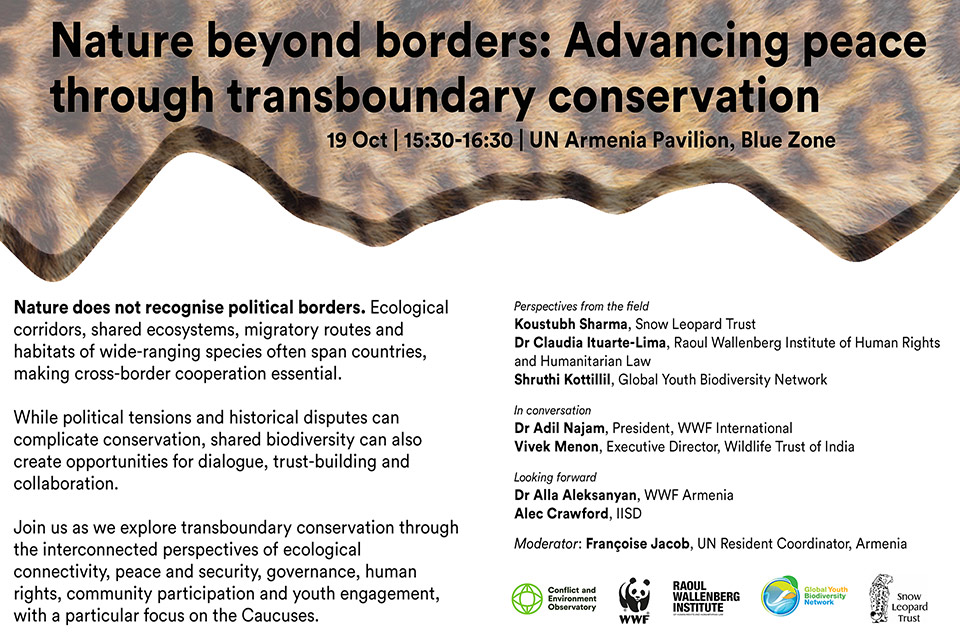
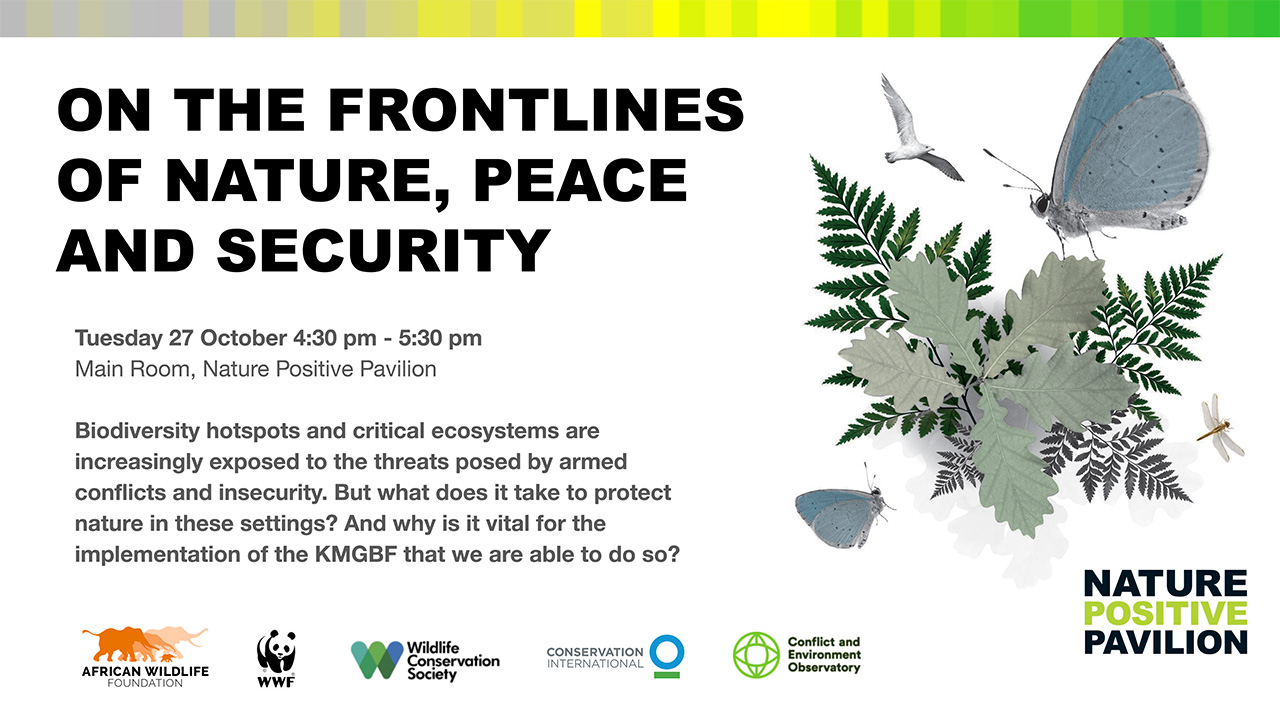
CEOBS is part of a loose network of conservation and peacebuilding organisations working to advance nature, peace and security goals at the CBD, and beyond, and which is convened under the Community of Practice on Environment, Climate, Conflict, and Peace (ECCP). Some of our fringe side events are below, and between us we’ll be working to ensure these themes are visible to attendees. If you’re interested in learning more about the network, or in participating, do reach out. Other side events include an event from the Republic of Korea’s on the CBD’s Peace and Biodiversity Dialogue Initiative, and another from the UK on “Nature Security”.

Beyond Yerevan
COP17 is a stepping stone in a longer-term strategy to mainstream peace and security in the CBD, and across other biodiversity spaces, with the ultimate aim being to translate that attention and awareness into meaningful change on the ground. Change that benefits nature, people and peace. Our collaborative mainstreaming journey began at COP16 in Cali, saw success at the 2025 World Conservation Congress, and we’re already considering opportunities for next year’s IUCN World Protected and Conserved Areas Congress, or the Parks Congress, as it’s known.
With this work now taking place against a backdrop of growing governmental attention on how peace and security interact with nature, there’s potential for new and exciting avenues for collaboration between governments and civil society. However, this will be contingent on whether nature can be securitised in ways that address the root causes of global biodiversity loss, rather than narrow national interests, and in ways that contribute to the political stability upon which nature and people depend.
Doug Weir is the Director of CEOBS and will be at COP17 if you would like to connect. If you’d like to support our work on nature, peace and security financially, you can donate here.