COP31’s agenda appears oblivious to the impact that conflict and instability have had on global energy policy and climate action this year.
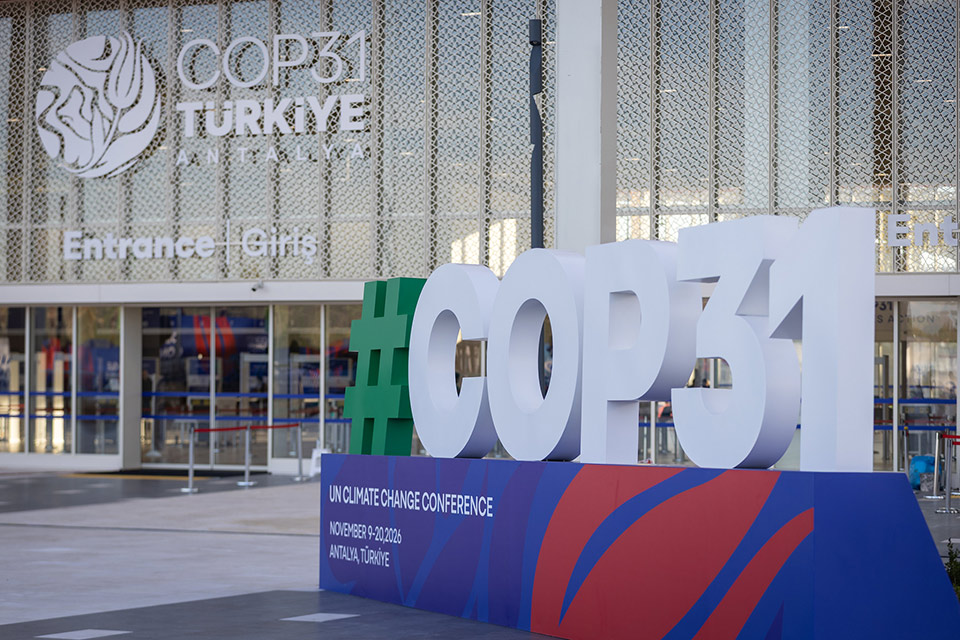
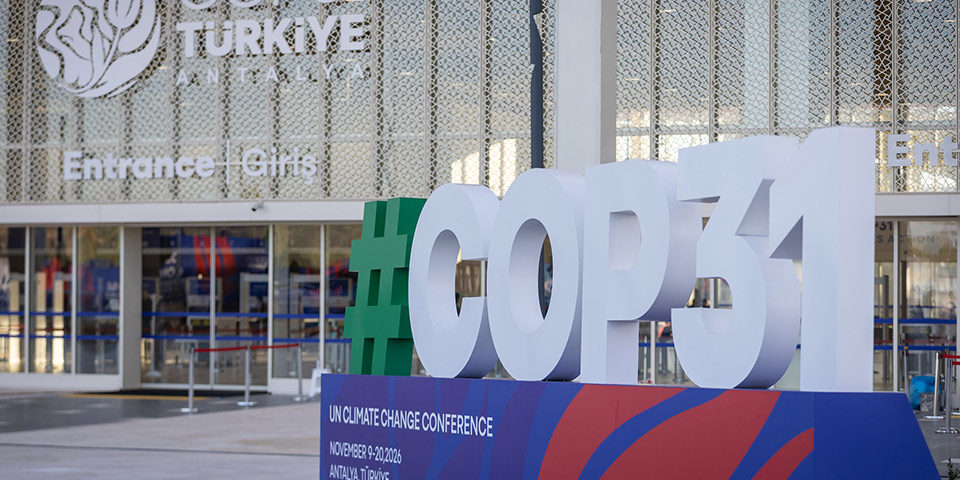
COP31 aspires to be a ‘COP of implementation’ but with world leaders distracted by wars, protests and elections, opportunities for progress may be limited. As governments, campaigners and fossil fuel lobbyists head to a seaside COP31, Ellie Kinney examines how conflict, climate and militarism will intersect in Antalya.
Welcome to Türkiye
This isn’t the first time this year where the world’s eyes have been on Türkiye; it hosted the NATO summit in July where President Erdoğan made headlines by gifting guests with their own personalised, gold plated revolver. While COP attendees might be disappointed with the contents of their obligatory free branded tote bag in comparison, the gift is symbolic of Türkiye’s positioning as a major defence supplier, not just for NATO and the EU but across Africa, Asia and the Gulf.
Alongside its international role in the arms trade, Türkiye recently proposed a 229% increase in defence spending over 2027-29 in a bid to reduce its dependence on foreign suppliers. It’s no surprise then that COP31 won’t host a thematic day on peace, despite the precedents set at COP28 and COP29, and its domestic relevance to Türkiye, and to the wider region.
Behind the scenes
COP31 is unusual for being co-hosted by Türkiye and Australia. Türkiye will lead on the ‘Action Agenda’ while Australia will ‘hold the gavel’, giving it authority over negotiations and formal decisions. Australian Prime Minister Anthony Albanese declared that “climate security is the new national security” at the UN General Assembly this September, but this importance hasn’t been reflected in the COP programming.
Nor has Australia acted on its own national climate risk assessment, which in 2022 set out domestic risks to Australian society, and identified risks to its defence and national security system as already high, and pushing very high to severe by 2050. The assessment found that impacts would stretch the system’s resources and funding “to their limits”.
Crackdowns on human rights
Trade unionists and human rights defenders have reportedly been detained in the run up to COP31. Similar forms of civil society repression were used this summer when Türkiye implemented a blanket ban on protests ahead of the NATO Summit, detaining more than 100 people including lawyers, academics and activists. Peace campaigners travelling from Germany to the Istanbul Peace Summit — which coincided with the NATO summit — also faced detention and deportation. Crackdowns on protest and the detention of spokespeople is becoming an all too common occurrence around climate COPs, with last year’s Brazilian COP offering only brief respite from a string of authoritarian host countries.
Actions can still take place within the UNFCCC ‘Blue Zone’ providing that they are authorised by the UNFCCC, and use pre-approved language and banners. But civil society repression outside of the venue risks COP taking place in a bubble where the people outside — those whose lives are increasingly impacted by climate breakdown — don’t get to voice their concerns and frustration with what happens inside.
The missing peace
With no thematic peace day, and no peace-related presidency initiatives, this year the topic risks slipping even further down COP’s agenda. This is both at odds with and perhaps explained by the current climate of geopolitical instability and rising militarism. This contrasts strongly with the growing clamour from international civil society on this topic: the People’s Climate Summit has a whole day dedicated to ‘democracy, anti-militarism and peace’. It also demonstrates the widening gulf between the conversations that happen within COPs and the world outside.
This is particularly pertinent this year as US and Israeli attacks on Iran have had reverberating global impacts on climate and energy policy, as well as for the food security of millions. Balendra Shah, Prime Minister of Nepal, put this plainly at the UN General Assembly, stating that Nepal is “hit by the climate we did not warm and hit again by the wars we did not start”. It’s becoming increasingly deluded for the COP process not to address how ongoing wars, insecurity and weakening multilateralism are disrupting global climate action.
Still on the programme
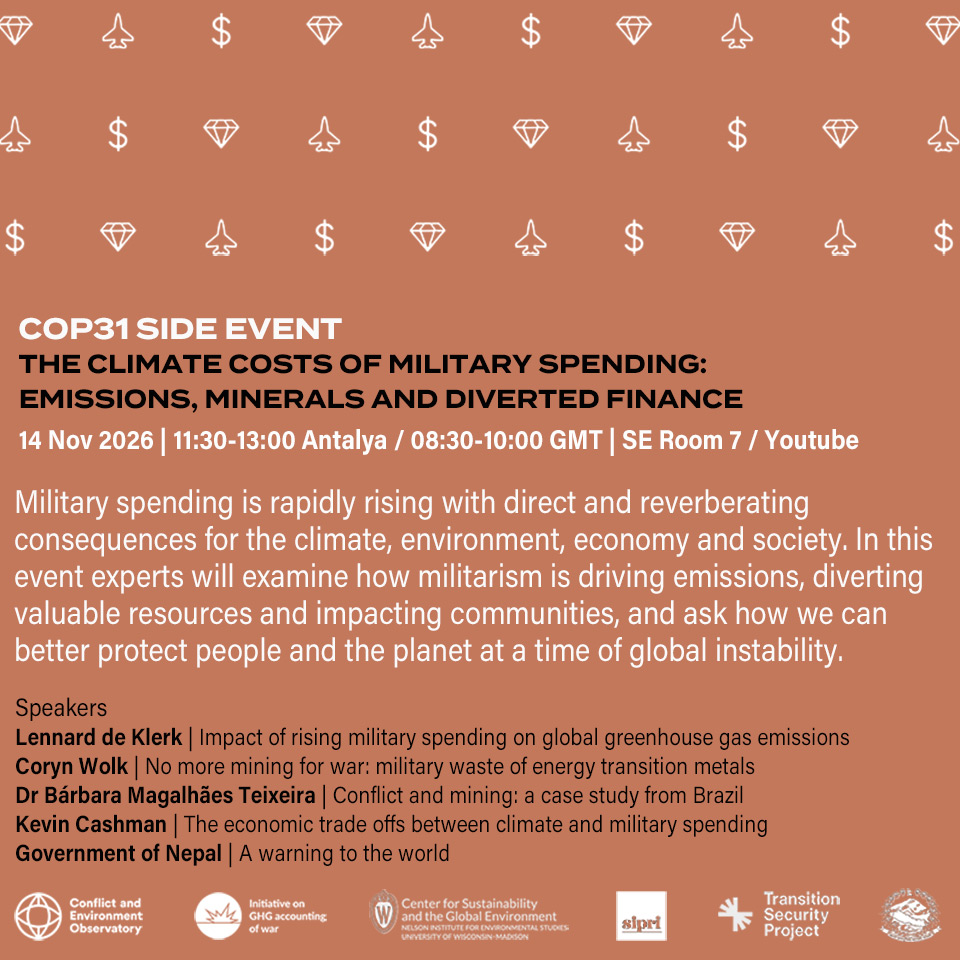
While conflicts and militarism are unlikely to feature in COP31’s final decision text, across the fortnight there are many events dedicated to the intersections between climate, peace and security. CEOBS is joining SIPRI and the University of Wisconsin-Madison’s Klinger Lab to host a side event on The Climate Costs of Military Spending: Emissions, Minerals and Diverted Finance. Experts from SIPRI, Klinger Lab, the Initiative on GHG Accounting of War, and the Transition Security Project will examine how rising militarism is driving emissions, redirecting valuable resources and impacting communities, and ask how we can better protect people and the planet at a time of global instability.
Other events like Climate (in)security and Ecocide, hosted by Ukraine, Estonia and Ukrainian civil society organisations, will highlight the ‘climate cost of aggression’. Ukraine used COP30 to call for $43bn in reparations for the 311m tonnes of CO₂-equivalent emissions caused by Russia’s invasion, and this year will likely see the country continue its push for accountability.
Time for a global reality check
COP31 marks the launch of the second Global Stocktake (GST), a two year process designed to evaluate progress towards the Paris Agreement, and which happens every five years. Since the last GST, the world has experienced its first year of temperatures surpassing 1.5°C above pre-industrial levels, while global military spending has risen by $444bn to a staggering $2.89tn.
Whilst the first GST failed to address the Military Emissions Gap, GST2 takes place against a backdrop of conflicts and division within the UNFCCC as resources are increasingly reallocated from climate finance to military spending. Because of this, the UNFCCC can expect increased attention on military emissions and military spending from across civil society around GST2. The process will provide an opportunity for a reality check; will the UNFCCC take this opportunity to address rising militarism, or continue to bury its head in the sand?
The military emissions gap widens
And when it comes to UNFCCC emissions data, our latest analysis found that military emissions transparency is getting worse. Last year saw the military emissions of the world’s two largest military spenders — the US and China — disappear from reporting, and this year COP host Turkiye has reported its military emissions as “not occuring” despite spending $25bn on its military in 2024.
This is a trend infecting UNFCCC reporting on the whole, with more and more governments hiding their military emissions despite escalating spending. Paired with analysis from our recent report Militaries and conflict: critical gaps in climate action, which found that no government has addressed the emissions from militaries within its Nationally Determined Contributions (NDCs) report, it raises questions of how seriously governments are taking the UNFCCC process given the large reporting and mitigation gaps caused by the exclusion of such a highly polluting sector.
On the road (to nowhere?)
Expect to hear a lot about roadmaps at this year’s COP, after COP30 president Brazil launched the first global roadmap for phasing out fossil fuels. This is not to be confused with the ongoing Transition Away from Fossil Fuels (TAFF) process, which began in Santa Marta earlier this year and which also sees governments publish roadmaps on reducing fossil fuel reliance. Irrespective of which process they are publishing on, governments will need to grapple with how to decarbonise their militaries; a question we’ve not seen sufficiently addressed by any government to date.
While military climate exceptionalism is deeply rooted within the UNFCCC, TAFF’s Santa Marta process could be an opportunity to take a fresh look at climate policy with a ‘coalition of the willing’. So far, militaries have been absent from the conversation around the energy transition, a policy gap that could leave states reliant on fossil fuel to power outdated military equipment for decades to come.
Show us the money
Mobilising climate finance has been a contentious issue in recent years, and grows even more so as military spending escalates. A recent report by SIPRI highlighted unprecedented cuts to Official Development Assistance — some of which is used to fund climate finance — in favour of increased military spending, which is now at a record $2.89tn globally.
Less than 10% of climate finance goes to fragile and conflict affected settings, while investing just 15% of annual military spending would more than cover the annual costs of climate adaptation in developing countries. But instead, we see investments in ‘security’ continue to drive insecurity globally.
Instead of further fuelling this disparity, and climate breakdown, governments attending COP31 should come prepared to invest in real security: meaningful climate action.
Ellie Kinney is CEOBS’s Senior Climate Advocacy Officer and will be at COP31 if you would like to connect. If you have found this post useful, please donate so that we can publish more.